

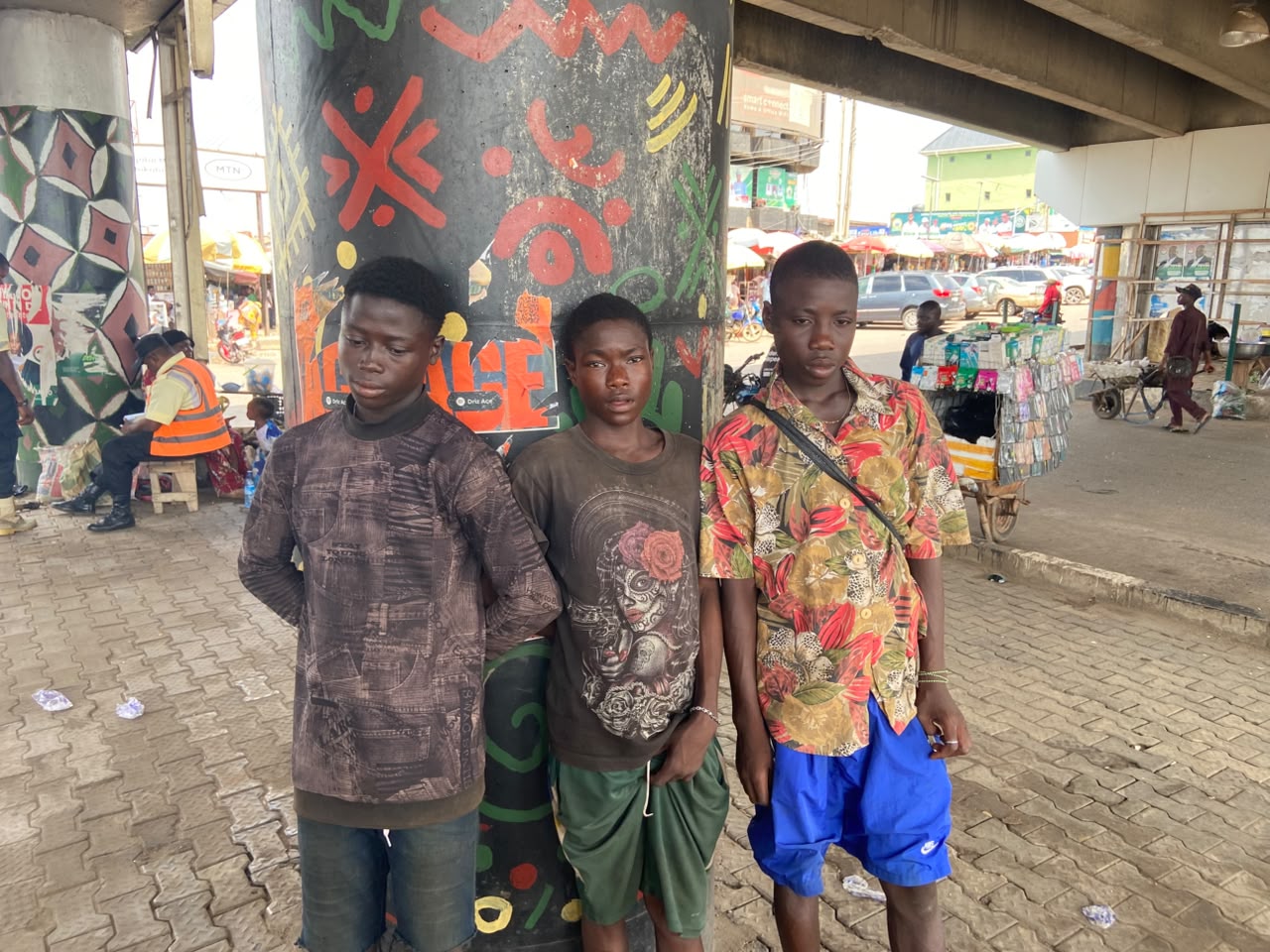
…One sleeps under bridge, another loses parents, three dream of better future
Razaq Adeyemi, Olamilekan Animasaun and Sherifat Usman
Three teenagers in Abeokuta, Ogun State, have narrated how poverty, parental loss and difficult living conditions forced them out of school and into scavenging for empty bottles and scrap materials to survive.
The teenagers, identified as Fawaz Adesola, 15; Ismail Abbas, 13; and Taiwo Olatoye, 17, were found picking discarded bottles and other recyclable materials around Panseke, Abeokuta, during school hours.

A visit by Platform Times to the area revealed the harsh reality of the young boys, who, instead of sitting in classrooms with their peers, spend their days searching for discarded materials to sell for money to buy food and meet their basic needs.
During separate interviews with Platform Times, the teenagers opened up about how they abandoned their education, their struggles on the streets, their sleeping conditions and their dreams of a better future.
For the three boys, what should ordinarily be a period of schooling, learning and preparing for adulthood has become a daily struggle for survival.
Fawaz: ‘I Dropped Out In SS1, I Need Someone To Sponsor Me’
Fawaz Adesola, 15, a former student of Lambo Secondary School, Obada, Abeokuta, said he had spent about three years collecting empty bottles to earn a living after leaving school.
Although he initially attributed his decision to leave school to the need to hustle, his circumstances point to the economic difficulties confronting children from vulnerable backgrounds.
Asked what he would do if someone offered to sponsor his education, Fawaz did not hesitate to express his willingness to return to the classroom.
“Yes, I will go back to school,” he said.
The teenager, who disclosed that he had learnt barbing, said he was also trying to acquire skills that could help him survive financially.
He, however, revealed that his living conditions remained difficult, adding that although he lived around Sabo, he usually slept under the bridge at Panseke.
Despite his circumstances, Fawaz has not abandoned his ambition of becoming an engineer.
His story reflects the difficult choices confronting some teenagers who must combine the desire for education with the immediate pressure to survive.
Ismail, 13, Sleeps Under Bridge, Sells Bottles For N400
For 13-year-old Ismail Abbas, childhood has also been defined by scavenging, uncertainty and life under a bridge.
Ismail, who hails from Ibere Kodo in Abeokuta, said he attended A.N.L.G. Primary School, beside Abeokuta North Local Government Secretariat, Akomoje, before proceeding to Ikiya High School.
He, however, dropped out in Junior Secondary School Three (JSS3), before sitting for his junior secondary school examination.
The teenager said he had been collecting empty bottles for about two years to earn money.
Explaining how he survives, Ismail said the money realised from selling the bottles was usually spent on food.
“After I sell a sack of bottles, the money I get from it, I use it to buy food,” he said.
Asked how much he makes from a sack of bottles, he explained that the amount depended on its weight but estimated that one sack could fetch about N400.
The 13-year-old also disclosed that he slept under the bridge in the Panseke area.
Despite his difficult circumstances, Ismail has a clear ambition for his future: becoming a mechanical engineer.
Asked whether he would return to school if someone offered to sponsor his education, he answered affirmatively.
“Yes,” he said.
Taiwo: ‘I Lost My Parents In Primary Two’
Unlike the other two teenagers, whose stories revolve largely around the struggle to meet their educational and financial needs, Taiwo Olatoye’s experience is also marked by the loss of both parents.
The 17-year-old, who hails from Itoko, Abeokuta, said he stopped attending school in Primary Five after losing his parents when he was in Primary Two.
He said some people in his neighbourhood took responsibility for supporting his education but could only assist him up to Primary Five.
“I lost my parents when I was in Primary Two, so I stayed with some area brothers who sponsored me to Primary Five, but they could not assist me anymore,” he said.
Taiwo, who attended St. Michael Primary School in Itoko, said he never proceeded to secondary school.
Recounting his journey before becoming a scavenger, he said he had travelled to Mushin, Lagos, where he worked under a bridge, assisting mechanics and people who came to purchase vehicle spare parts.
He later returned to Abeokuta and worked with meat sellers, helping to unload meat at the market.
However, he said a disagreement with his employer forced him to leave the job.
Taiwo disclosed that he started gathering scrap materials around July 2026 and sometimes slept around the Panseke area.
Asked about his childhood ambition, he said he once hoped to become a soldier, but his experience had changed his immediate priorities.
Although he had earlier expressed interest in becoming a soldier, he said he was no longer interested in returning to formal education.
“I don’t want to go to school. I wish to learn furniture work as a vocational skill,” he said.
He added that he could already do some furniture work and hoped to develop the skill into a means of livelihood.
Three Boys, Three Stories, One Common Struggle
Although the teenagers have different backgrounds and experiences, their stories share a disturbing similarity: they have been pushed out of the classroom and into the streets, where daily survival takes priority over education.
While Fawaz and Ismail expressed their willingness to return to school if educational sponsorship became available, Taiwo said he preferred vocational training, particularly furniture making.
Their accounts also raise concerns about the living conditions of vulnerable children and teenagers who spend their days scavenging around public spaces and sometimes sleep under bridges.
For Ismail, a 13-year-old who should ordinarily be in school, selling a sack of empty bottles for about N400 is a means of securing his next meal.
For Fawaz, sleeping under a bridge has become part of his survival routine, despite his desire to become an engineer.
And for Taiwo, the death of his parents and the eventual withdrawal of support from those who initially helped him have shaped a childhood without the opportunity to proceed beyond primary school.
Their experiences highlight the need for stronger interventions to identify out-of-school children, provide educational assistance to vulnerable families and expand access to vocational training for teenagers who may not wish to return to formal education.
They also present an opportunity for relevant government agencies, particularly the Ogun State Ministry of Education and the Ministry of Women Affairs and Social Development, as well as child-protection organisations and philanthropists, to examine the circumstances pushing children into street-based survival.
Beyond their immediate need for food and shelter, the three teenagers have something else in common: they still hope for a future better than their present circumstances.
For two of them, that future begins with a return to school. For the third, it begins with an opportunity to learn a trade.
But for now, while their peers are learning in classrooms, they are searching through discarded bottles and scrap materials on the streets of Abeokuta.


Do you want to share a story with us? Do you want to advertise with us? Do you need publicity for a product, service, or event? Contact us on WhatsApp +2348183319097 Email: platformtimes@gmail.com
We are committed to impactful investigative journalism for human interest and social justice. Your donation will help us tell more stories. Kindly donate any amount HERE