
…Jigawa Tops 34-State Ranking With 29.9%, Ekiti, Nasarawa Follow
…Akwa Ibom Records Lowest Commitment At 0.6%, Imo Gets 4.2%
…Ogun Spends N36.58bn In H1 2026, Ranks 13th
Daud Olatunji
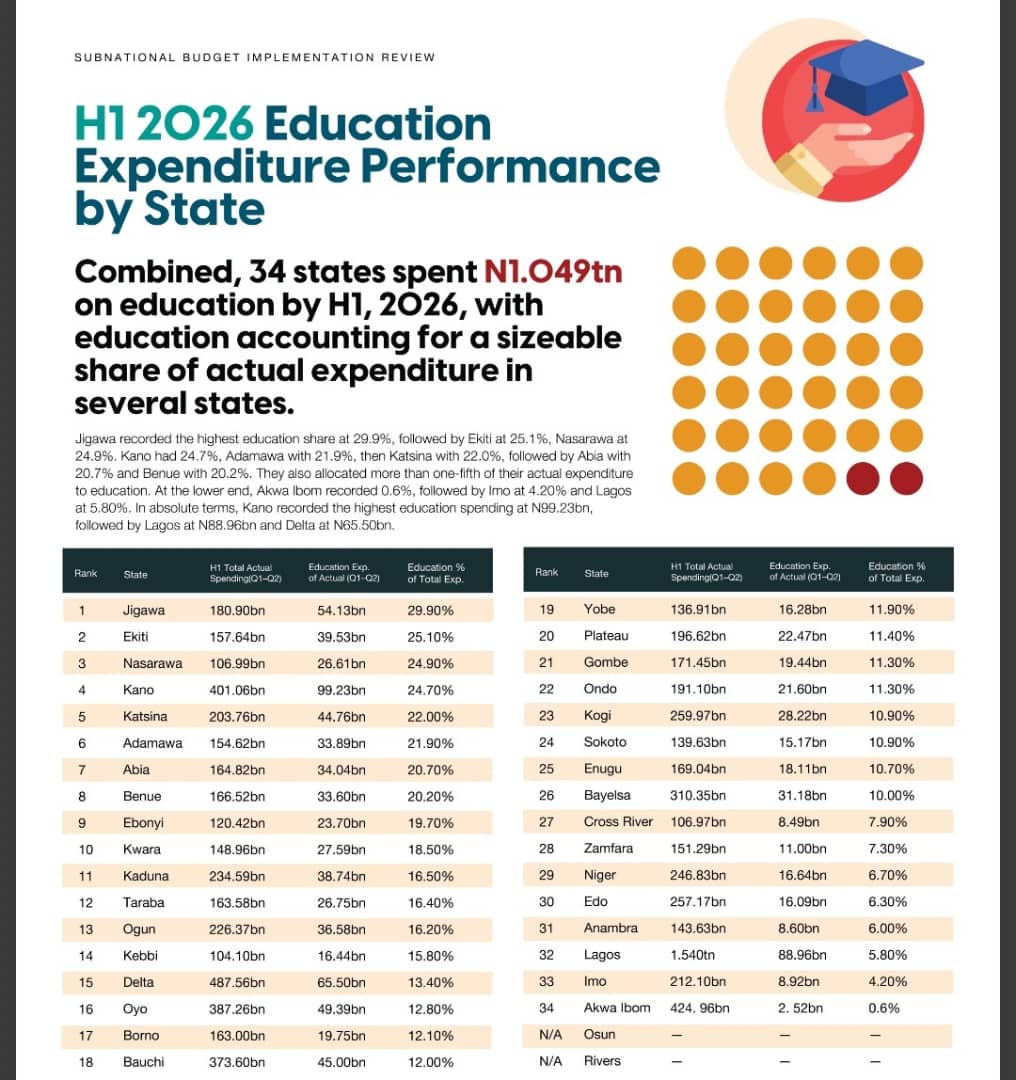
A fresh fiscal performance report by BudgIT has exposed significant disparities in education spending among Nigerian states, with Lagos, despite recording the country’s second-highest actual expenditure on education in absolute terms, allocating just 5.8 per cent of its total expenditure to the sector in the first half of 2026.
The findings also showed that Akwa Ibom devoted a paltry 0.6 per cent of its total expenditure to education, making it the lowest-performing state among the 34 states assessed, while Imo and Lagos recorded 4.2 and 5.8 per cent respectively.
In contrast, Jigawa emerged as the state with the highest proportion of expenditure devoted to education, committing 29.9 per cent of its actual expenditure to the sector, followed by Ekiti with 25.1 per cent and Nasarawa with 24.9 per cent.
The findings were contained in BudgIT’s H1 2026 Education Expenditure Performance by State, published on October 21, 2026, as part of its Subnational Budget Implementation Review.
According to the report, the 34 states collectively spent N1.049tn on education between January and June 2026, although the level of commitment varied considerably across the states.
BudgIT observed that education accounted for a sizeable share of actual expenditure in several states, but the figures also revealed substantial differences in the priority governments attached to the sector.
The report stated, “Combined, 34 states spent N1.049tn on education by H1, 2026, with education accounting for a sizeable share of actual expenditure in several states.”
A breakdown of the figures showed that Kano recorded the highest actual education expenditure, spending N99.23bn, representing 24.7 per cent of its total expenditure.
Lagos followed with N88.96bn, but the amount represented only 5.8 per cent of its total actual expenditure of N1.540tn, raising questions about the relationship between the state’s huge spending capacity and its relative fiscal commitment to education.
Delta ranked third in absolute education expenditure with N65.50bn, representing 13.4 per cent of its total expenditure of N487.56bn.
Jigawa, however, recorded the highest education spending proportion despite having a considerably smaller overall expenditure than Lagos, Kano and Delta.
The state spent N54.13bn on education out of its N180.90bn total expenditure, translating to 29.9 per cent.
Ekiti committed N39.53bn out of N157.64bn to education, representing 25.1 per cent, while Nasarawa spent N26.61bn from its N106.99bn expenditure, accounting for 24.9 per cent.
The figures suggest that the states with the highest overall spending are not necessarily those devoting the largest proportion of their financial resources to education.
Ogun Spends N36.58bn, Ranks 13th
In Ogun State, the report showed that the government spent N36.58bn on education during the first half of 2026, representing 16.2 per cent of its total actual expenditure of N226.37bn.
The state ranked 13th among the 34 states assessed in terms of the proportion of expenditure devoted to education.
Although Ogun’s 16.2 per cent performance placed it above several states, it remained significantly below the leading states, particularly Jigawa, Ekiti and Nasarawa, which committed between 24.9 and 29.9 per cent of their expenditure to the sector.
Ogun’s performance also placed it above Lagos, which allocated just 5.8 per cent of its much larger N1.540tn expenditure to education.
The figures provide an opportunity to examine the Ogun government’s education priorities beyond budget announcements and proposed allocations, particularly the extent to which approved funds are translated into actual expenditure.
However, the report does not establish whether the amount spent has translated into improved learning outcomes, better school infrastructure, adequate teaching personnel or improved access to quality education.
Such an assessment would require further examination of project-level expenditure, school infrastructure, teacher recruitment, classroom conditions and learning outcomes across the state.
Akwa Ibom, Imo Record Lowest Commitments
At the bottom of the ranking, Akwa Ibom recorded the lowest education expenditure proportion, spending N2.52bn out of its N424.96bn total expenditure, representing just 0.6 per cent.
Imo followed with N8.92bn out of N212.10bn, accounting for 4.2 per cent, while Lagos occupied the third-lowest position with 5.8 per cent.
Anambra spent N8.60bn, representing six per cent of its N143.63bn expenditure, while Edo committed N16.09bn out of N257.17bn, equivalent to 6.3 per cent.
Niger allocated 6.7 per cent of its total expenditure to education, while Zamfara recorded 7.3 per cent and Cross River 7.9 per cent.
The figures expose the wide gap in the priority given to education across the federation, with Jigawa’s 29.9 per cent commitment standing in sharp contrast to Akwa Ibom’s 0.6 per cent.
SOUTH-WEST STATES: WIDE SPENDING GAPS
A closer examination of the South-West revealed considerable differences in the proportion of resources devoted to education.
Ekiti led the region and ranked second nationally, spending N39.53bn, representing 25.1 per cent of its total expenditure.
Ogun followed with N36.58bn, accounting for 16.2 per cent, while Oyo spent N49.39bn, representing 12.8 per cent of its N387.26bn total expenditure.
Ondo committed N21.60bn to education out of N191.10bn, representing 11.3 per cent, while Lagos spent N88.96bn, accounting for 5.8 per cent of its total expenditure.
The figures show that although Lagos recorded the highest overall expenditure among the states examined, its education spending proportion was substantially lower than those of Ekiti, Ogun, Oyo and Ondo.
The regional comparison also highlights the difference between the volume of money spent and the level of priority given to education within a state’s overall expenditure.
TRANSPARENCY QUESTIONS AS OSUN, RIVERS DISAPPEAR FROM RANKING
Meanwhile, BudgIT raised concerns over the absence of second-quarter 2026 budget implementation reports for Osun and Rivers states, making it impossible to assess their education expenditure performance alongside the other 34 states.
The organisation specifically identified the development as a transparency gap.
In the infographic, BudgIT stated: “The Q2 2026 Budget Implementation Reports for Rivers and Osun States were not available at the time of this analysis.”
It added that the absence of the reports meant their actual expenditure performance could not be assessed or compared with those of other states.
Consequently, Osun and Rivers were listed without expenditure figures or rankings in the assessment.
The development raises concerns about public access to information on how state governments implement approved budgets, particularly in a critical sector such as education.
Without timely and accessible budget implementation reports, citizens, civil society organisations and other accountability institutions are unable to independently assess government spending, identify implementation gaps or determine whether public funds are being deployed as approved.
Beyond the headline figures, the BudgIT assessment underscores the importance of examining actual expenditure rather than relying exclusively on budgetary promises and allocations.
While the N1.049tn spent by the 34 states represents a substantial financial commitment, the wide variations in spending proportions, particularly the gap between Jigawa’s 29.9 per cent and Akwa Ibom’s 0.6 per cent, demonstrate the uneven fiscal priority accorded to education across the country.
The critical question, however, is whether the reported expenditure is translating into better classrooms, equipped laboratories, adequate learning materials, improved teacher welfare and measurable improvements in educational outcomes.
 '
 '
Do you want to share a story with us? Do you want to advertise with us? Do you need publicity for a product, service, or event? Contact us on WhatsApp +2348183319097 Email: platformtimes@gmail.com
We are committed to impactful investigative journalism for human interest and social justice. Your donation will help us tell more stories. Kindly donate any amount HERE
 '
