

….MTN, Glo Absent As Subscribers Decry Data Depletion, Dropped Calls, Rising Tariffs
…Civil Society Demands NCC, National Assembly Summon Service Providers Over Complaint
Daud Olatunji
Major telecommunications operators, including MTN and Globacom, came under fire on Thursday after they failed to attend a national civil society dialogue convened to address growing complaints over the quality, cost and transparency of telecommunications and data services in Nigeria.
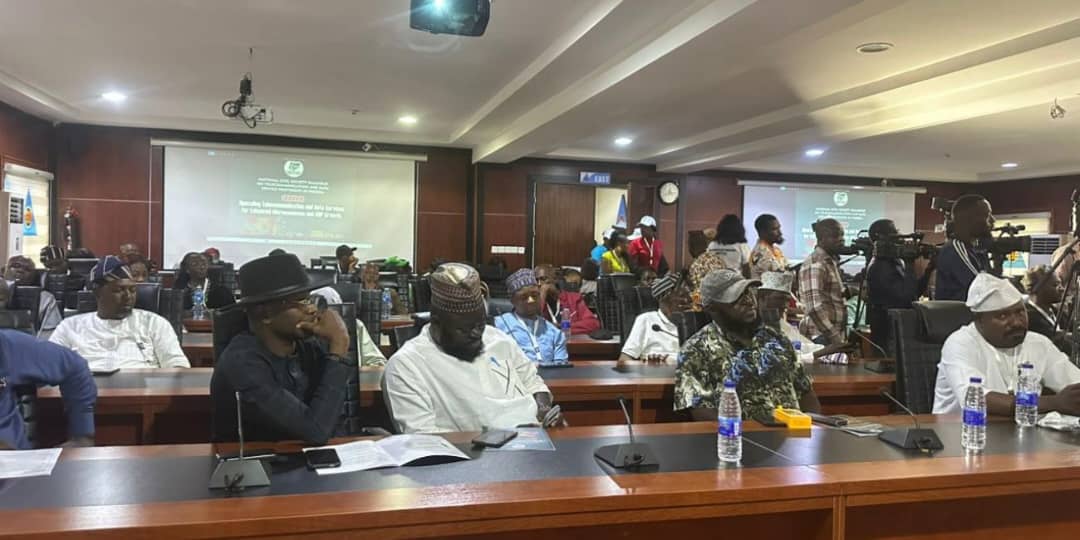
The operators were conspicuously absent from the National Civil Society Dialogue on Telecommunication and Data Service Provision in Nigeria, held at the Nigerian Army Resources Centre, Asokoro, Abuja.
The meeting was designed as a tripartite engagement involving telecom operators, regulators and consumers, but the absence of the service providers did not stop participants from pressing for stronger regulatory measures and greater accountability in the industry.
Participants expressed anger over what they described as persistent consumer exploitation through unexplained data depletion, dropped calls, high tariffs and poor service delivery.
The absence of the operators also became one of the dominant issues at the meeting, with participants condemning what they viewed as a refusal to directly engage consumers over their grievances.
Delivering the keynote address, the Special Adviser to the President on Media and Public Communications, Dr Sunday Akin Dare, acknowledged the strategic importance of telecommunications to Nigeria’s economy but stressed that rapid industry growth must translate into better services for subscribers.
Dare said active telecommunications subscriptions were approaching 190 million, while broadband penetration had exceeded 50 per cent.
He, however, warned that increasing subscriber numbers and industry investment would mean little if consumers continued to experience unreliable services.
“Growth in subscriber numbers alone is not enough. The quality of service experienced by citizens must improve at the same pace as investment and expansion.”
According to him, Nigerian consumers now expect reliability, transparency and value for money from telecommunications providers.
While recognising the difficult operating environment confronting telecom companies, Dare cited rising energy costs, foreign exchange pressures, multiple taxation and infrastructure vandalism as some of the challenges affecting operators.
He nevertheless called for a renewed social contract between telecom companies and their customers.
He demanded greater transparency in billing, simplified consumer usage dashboards and increased investment in network optimisation.
The government representative’s position, however, did little to calm participants who insisted that consumers had endured years of poor services and opaque billing practices.
The convener of the dialogue and President of the National Civil Society Dialogue movement, Comrade Blessing Akinlosotu, expressed disappointment over the operators’ absence.
Akinlosotu and other participants pointed to the empty seats reserved for representatives of the telecommunications companies as evidence, in their view, of the industry’s reluctance to face consumers directly.
A participant, Mrs Grace, called for immediate action by regulators and lawmakers against operators accused of violating subscribers’ rights.
“The Nigerian Communications Commission and the National Assembly must summon these service providers without delay to answer for this relentless, predatory exploitation of the masses.”
The demand comes amid sustained public complaints over sudden data depletion, recurring call drops, inconsistent network quality and the rising cost of telecommunications services.
The dialogue ended with the adoption of a 10-point communiqué containing demands aimed at strengthening consumer protection and improving service delivery across the telecommunications sector.
Among the key demands were stricter monitoring of quality of service, stronger infrastructure sharing arrangements and enhanced consumer protection mechanisms.
The participants also called for greater transparency in the relationship between operators and subscribers, insisting that consumers should be able to clearly understand their data usage, billing and service charges.
The dialogue further reinforced the position that telecommunications should be treated as a strategic national asset whose development must be matched by effective protection of millions of Nigerians who depend on digital services for communication, business, education and other daily activities.
The participants maintained that the growth of Nigeria’s telecommunications sector should no longer be measured only by subscription figures and broadband expansion, but also by the quality, affordability, transparency and reliability of services delivered to consumers.
With the operators absent from the Abuja engagement, attention is now expected to shift to the Nigerian Communications Commission and the National Assembly over whether stronger regulatory and legislative action will follow the demands raised at the dialogue.
 '
' '
'Do you want to share a story with us? Do you want to advertise with us? Do you need publicity for a product, service, or event? Contact us on WhatsApp +2348183319097 Email: platformtimes@gmail.com
We are committed to impactful investigative journalism for human interest and social justice. Your donation will help us tell more stories. Kindly donate any amount HERE
