

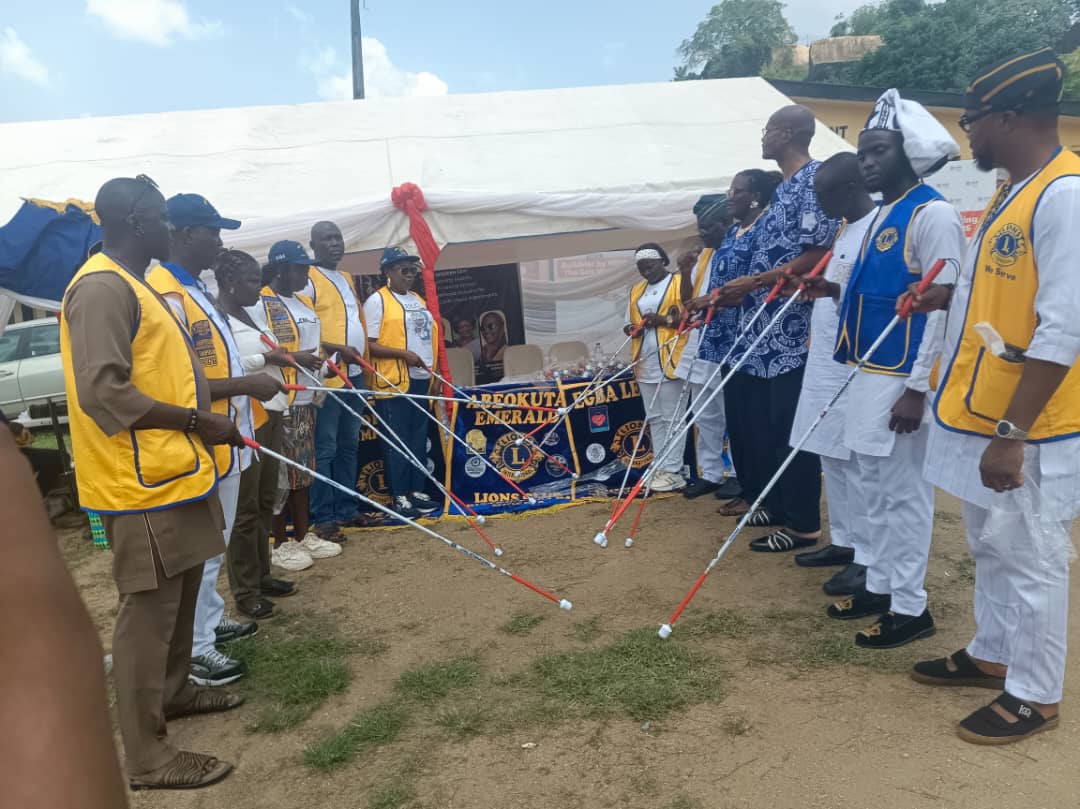
….Lions donate 50 white canes, give ₦250,000 cash grants to five beneficiaries
….Beyond Limits provides livelihood equipment to four NAB members, supports event logistics
Firdaus Obiremi
Persons with visual impairments have called on governments, financial institutions and other stakeholders to dismantle discriminatory barriers and provide accessible infrastructure, employment opportunities and equal access to essential services.
They also urged authorities to move beyond temporary financial handouts and charity-based interventions towards sustainable policies that guarantee the independence, dignity and economic empowerment of persons with disabilities.
The stakeholders made the call on Friday in Abeokuta, Ogun State, during the 2026 International White Cane Safety Day and Empowerment Programme organised by the Nigerian Association of the Blind, Abeokuta South Chapter, with the Lions Club International, District 404B-4 Nigeria, Abeokuta Axis, serving as the lead sponsor and host organisation.
The programme, themed, “Knights of the Blind in the Modern Era: Championing Mobility, Digital Financial Access, and Livelihood Inclusion for Persons with Visual Impairments,” featured a public sensitisation walk, empowerment initiatives and advocacy for the rights of persons with visual impairments.
The Lions Club donated 50 white canes to members of the association to support safe and independent movement, while five beneficiaries received cash grants of ₦50,000 each, amounting to ₦250,000, to assist with their personal needs and economic activities.
The club also supported logistics for the awareness walk, which took participants through major thoroughfares in Abeokuta, including Panseke and Oke-Ilewo, before concluding at the venue of the main reception.
The interventions were coordinated under the leadership of the Chairperson of Vision and Sight for the Abeokuta Axis, Lion Muhmeen Akintola Akinsanya, while the opening remarks were delivered by a Past District Governor, PDG Taiwo Fatoki.
Fatoki, who holds the distinctions PMJF and NLCF, reaffirmed the Lions Club’s commitment to humanitarian service, vision preservation and initiatives that promote the independence and inclusion of persons with disabilities.
Another key partner, the Beyond Limits Initiative for Women and Girls with Disabilities, supported the programme by securing the venue, hosting the reception and providing administrative and human-resource assistance.
Beyond Limits also presented livelihood equipment, including blenders, electric kettles, pressing irons and toasters, to four members of the association to support their domestic needs and income-generating activities.
The interventions highlighted the contributions of both organisations to improving the welfare of persons with visual impairments through mobility support, direct financial assistance, livelihood resources and community awareness.
Speaking at the event, the Chairperson of the NAB Abeokuta South Chapter, Mrs Oluwatomisi Adeyefa Olatayo, said persons with visual impairments wanted equal opportunities to participate in society rather than being treated as objects of pity.
Olatayo stressed that persons with disabilities should be included in decision-making processes and given the necessary support to pursue education, employment and other livelihood opportunities.
“We want to live in a society free from discrimination and stigma, where we are free to live as humanly as possible,” she said.
She urged members of the public to replace sympathy-driven interventions with genuine support for disability rights, insisting that persons with visual impairments deserved opportunities to become self-reliant.
“The Bible says to love your neighbour as yourself. Love us genuinely; do not pity us. We want the opportunity to thrive, not charity or peanuts. Disability rights are human rights,” she added.
Olatayo expressed appreciation to the Lions Club Abeokuta Family, Beyond Limits Initiative for Women and Girls with Disabilities and other supporting organisations for their contributions to the programme and their commitment to advancing the welfare of persons with disabilities.
She, however, emphasised the need for sustained interventions that would enable visually impaired Nigerians to live independently and participate meaningfully in society.
In his keynote address, a Solicitor of the Supreme Court of Nigeria and co-founder of Aiding the Blind in Nigeria, Barrister Olayinka Komolafe, said the major challenge confronting visually impaired Nigerians was not blindness itself but the institutional and environmental barriers restricting their independence.
Referencing Helen Keller’s 1925 address to members of the Lions Club, in which she challenged them to become “knights of the blind in the crusade against darkness,” Komolafe said the modern-day struggle required society to confront discriminatory systems rather than view blindness as a personal limitation.
“The real darkness in Nigeria is not blindness—it is the systemic barriers that turn blindness into a disability,” he said.
Komolafe criticised the poor state of pedestrian infrastructure, warning that distributing white canes without providing safe walkways, tactile paving, accessible audio traffic signals and specialised orientation and mobility training would not adequately address the difficulties faced by visually impaired people.
He cited Section 5 of the Discrimination Against Persons with Disabilities (Prohibition) Act, 2018, which provides for accessibility in public buildings and infrastructure, including pedestrian walkways, and lamented what he described as inadequate implementation of the law.
The legal practitioner also raised concerns about the exclusion of visually impaired people from digital financial services, particularly automated teller machines and mobile banking applications that lack adequate accessibility features.
According to him, the situation sometimes forces visually impaired customers to depend on other people to conduct financial transactions, exposing their confidential personal identification numbers and compromising their financial security.
He urged commercial banks to make their digital platforms accessible, equip their facilities with appropriate assistive technology and train employees to serve customers with disabilities professionally.
Komolafe further called on banks to review requirements that compel visually impaired account holders to sign indemnity forms, arguing that such practices could create additional barriers to financial inclusion.
On economic empowerment, he cited World Health Organisation data which he said showed that 80 per cent of visually impaired Nigerians lived in poverty because of unemployment and inadequate access to capital.
He urged government agencies, civil society organisations and development partners to expand access to vocational training, business financing and sustainable livelihood programmes for persons with visual impairments.
Komolafe maintained that genuine inclusion required more than the provision of mobility aids, stressing that governments and private institutions must create an environment in which persons with disabilities could move freely, access services independently and participate fully in economic and social life.
“The white cane is a symbol of independence, not a symbol of pity,” he said, urging visually impaired Nigerians to continue advocating for the enforcement of disability rights and the removal of barriers to equal participation.
The programme underscored the complementary roles of the Lions Club and Beyond Limits Initiative in supporting persons with visual impairments, with the former providing mobility aids and cash grants and the latter facilitating the event and supplying livelihood equipment.
The stakeholders maintained that while such interventions were important, lasting inclusion would depend on stronger enforcement of disability rights legislation, accessible public infrastructure, inclusive digital financial services and sustainable employment opportunities.
They called on governments, businesses, civil society organisations and communities to translate commitments to disability inclusion into practical measures that guarantee dignity, independence and equal participation for persons with visual impairments.
 '
 '
Do you want to share a story with us? Do you want to advertise with us? Do you need publicity for a product, service, or event? Contact us on WhatsApp +2348183319097 Email: platformtimes@gmail.com
We are committed to impactful investigative journalism for human interest and social justice. Your donation will help us tell more stories. Kindly donate any amount HERE
 '
