

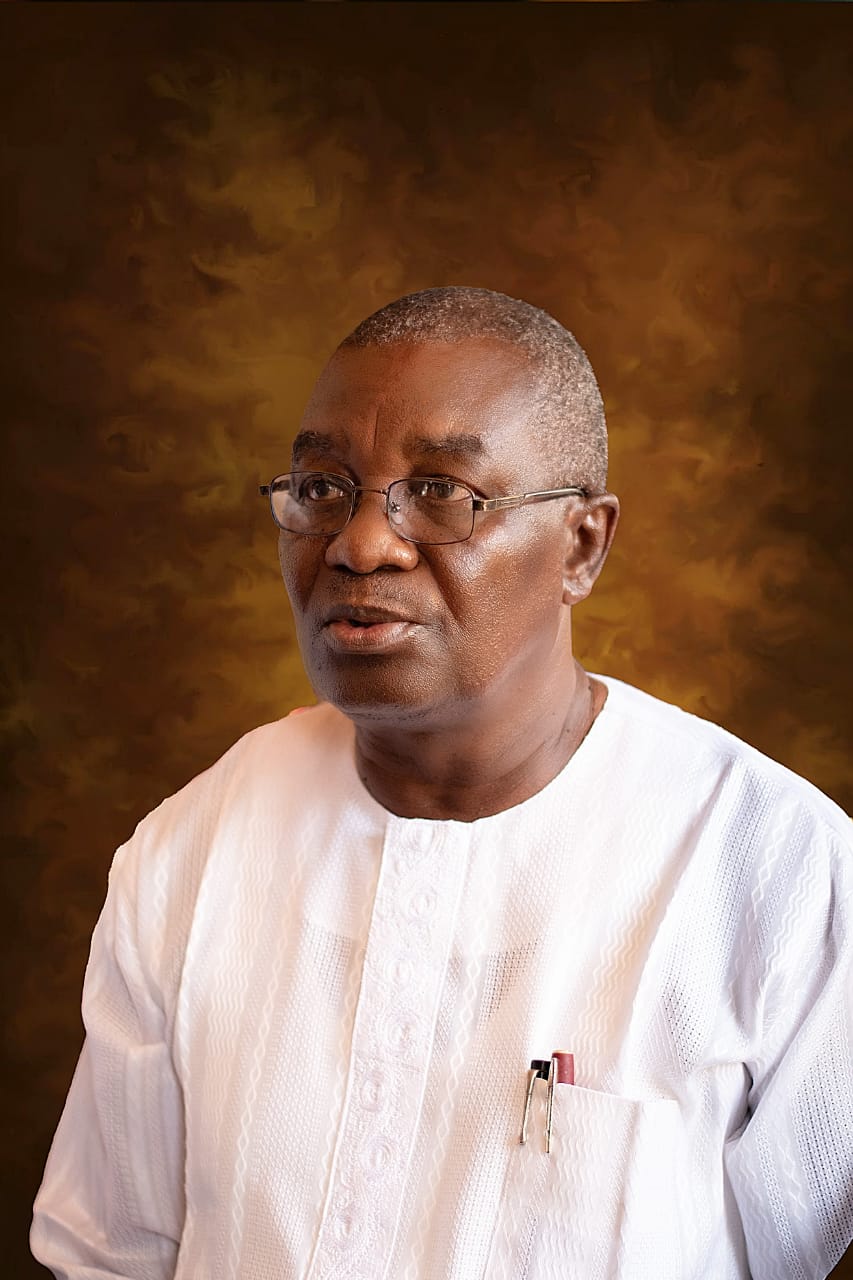
BY Gbenga Gbesan
What could have been behind the thinking of Lawyer Anderson Asemota, the Abuja-based founder and Managing Partner of Neplus Ultra Attorneys in petitioning on behalf of a client who would publicly disown him that, “I have never spoken with or met the lawyer, Anderson Asemota of Neplus Ultra Attorneys, alleged to have written the petition on my behalf?” A highbrow legal practitioner as contained in his public profile, Anderson had “personally handled and participated in over 30 election petition cases and over 100 regular civil matters.”
On Wednesday, 14 October 2026, the lawyer had written a petition on behalf of one Topa Olusegun Peter (‘TOP’). According to the media reports, the lawyer claimed ‘TOP’ (whose first name ‘Topa’ will be adopted in this write-up), was “a governorship aspirant of the Peoples Democratic Party (PDP) in Ogun State.”
He gave the “Independent National Electoral Commission (INEC) 48 hours to explain his [Topa’s] omission from the list of candidates for the February 6, 2027 governorship election” in Ogun State. The authenticity of the lawyer’s letter to the INEC was confirmed by Nigerian newspaper, The Guardian, of 15 October 2026 because “a copy of the letter … was sighted by The Guardian.”
As lawyers are fond of saying, Anderson was well-apprised of his “client’s” case. He was succinct in the correspondence. “Peter,” he claimed, “obtained the party’s expression of interest and nomination forms on May 12, 2026.” He would go on to participate in the party’s governorship primary held on May 27. Where the primary was held? It was not indicated. Who were the officials who conducted the primary? That information was also missing.
The lawyer, however, further claimed “that the PDP forwarded his nomination particulars to INEC.” In addition, “his name appeared as entry number 15,783 on the party’s membership register submitted to the commission.” The grouse, therefore, was “INEC’s final list of candidates, published on October 10, [which,] did not contain Peter’s name.”
This was against the fact that “he is the party’s duly nominated candidate,” according to the lawyer. Peter’s demand as contained in the letter was that the commission should verify “his nomination records and publish his name as the PDP candidate if its records confirm that he was duly nominated and there is no lawful basis for his exclusion.” The lawyer “warned that failure to provide a substantive response within the stipulated period … could lead to court proceedings….”
Paradoxically, where reaction came from was unexpected. The very man, Topa Olusegun Peter, whose cause was being fought was the one who threw the gauntlet. He called the media together in Abeokuta on Saturday, 17 October 2026, about three days after the purported petition was supposed to have reached the desk of the INEC chairman in Abuja. He repudiated the petition and its writer. Topa was consternated.
Anderson, he alleged, had made “unauthorised use of his name.” Firmly, he “denied knowing or authorising the lawyer to act on his behalf.” That was a damning allegation to make, accusing a lawyer of fabrication, identity theft and misrepresentation. But Topa was however resolute. He maintained, unwaveringly, that he “was shocked and deeply surprised to discover that my name had appeared in newspaper publications as a governorship aspirant under the Peoples Democratic Party (PDP).” Categorically, he stated, it was “an aspiration I know absolutely nothing about.”
What could have happened? He had explanations. Though the Baale of Olorunsogo community located in the border area of Ogun State in Ilara axis of the Imeko-Afon Local Government Area, he was also an active politician. Topa belonged to the PDP. “I have been a loyal member of the PDP since 1998, the year the party was formed….,” he said. The road to the scandal began when one Ramoni Adebolu, the chairman of All Progressives Congress (APC) in their local government, Imeko-Afon, led some of his party stalwarts to him.
They met him in his Ilara home with a proposition. They had a “political position to offer him.” Although they let him realise that “the position was under the PDP,” but didn’t “explain its exact nature” to him. Topa said he wasn’t persuaded. Thus, “he immediately rejected the offer.”
He turned Adebolu and his group away. Stoutly, he let them realise that “he was not interested in the arrangement.” He had his suspicion telling them if there had to be any offer of position to him, “such could only come from my party, the PDP,” Topa stated.
Topa explained that what happened next was the baffling scandal. Confronting him were various “newspaper publications [that] identified him as a PDP governorship aspirant.” Taken aback, “he immediately contacted Adebolu to seek clarification.” Adebolu was mollifying. He brought to Topa a peace offering of “calm and promised … financial benefits and a car.” And there would be more: “after the emergence of Adeola (Yayi) as the APC’s governorship candidate,” Topa quoted Adebolu as saying.
But Topa was bothered instead of being mollified. Troubling to him were: one that the alleged petition was submitted to INEC in his name; two, that a lawyer had written on his behalf without his knowledge or authorisation; and three, that documents were submitted in his name without his consent. One important fact he wanted the public to know was that nothing transactional took place between him and Adebolu with his group.
“For the avoidance of doubt, I did not collect any money from the individuals mentioned in this statement,” he reiterated.
The local APC Imeko-Afon leader, Ramoni Adebolu, that Topa had placed at the centre of the scandal denied any complicity. In his reaction to The Punch newspaper on 19 October 2026, he flatly denied “knowing anything about the publication which presented Topa as the PDP governorship candidate for Ogun State.”
He didn’t however deny pitching of party-swapping to Topa. Expectedly as party’s operatives from the same local government, both – Topa and Adebolu – knew each other. Indeed, the two of them once belonged to the same party: PDP. “I have known Mr Peter since our days in the PDP during the government of former Governor Gbenga Daniel,” Adebolu admitted. Now, they belonged to different political camps.
Adebolu saw nothing wrong nor illegitimate in reaching out to “Mr Peter and others with a view to convincing them to join the ruling party.” So, as the APC chairman in Imeko-Afon Local Government, he held a meeting with Topa, sold the idea of party switching to him with a promise “that we shall duly accommodate them and ensure that they are also recognised in the scheme of things in the party,” he explained.
Adebolu saw his actions as within legal and democratic bounds of winning opposition figures to his party with a view to “further strengthen my party in the local government.” Outside this plain act of politically trying to win Topa to APC’s side, Adebolu said, “there was never a time I discussed anything else.” Firmly, he denied knowing anything about the publication.
“I don’t know anything about the newspaper report,” repeating again for emphasis, “I know nothing about the publication.” In other words, he too did not have anything to do with Anderson Asemota and his petition.
So, who did? Topa Olusegun Peter, the man around whom the scandal was woven denied being part of the plot. The Imeko-Afon APC local chief, Ramoni Adebolu, in whose direction Topa had pointed an accusing finger washed himself clean of the scandal. So, who engineered the political disgrace?
Politicians however are not people of truth. The most convenient thing for them to do is lie. Can Topa himself be lying? Could it be a case of entrapment? Could he have played along to the knowledge of his PDP base in Ogun State when he was approached and waited till when the scandal had become full-blown, then deliberately shifted the infamy to APC, thus he and his party achieving their aim of tainting their main opposition party with the disapproving behaviour to hurt their 2027 chances? This is of course possible because nothing is impossible with politicians.
Except in this case, some attendant facts do not support the logic. The first is that Ramoni Adebolu would have hurt any attempt at wriggling out by Topa if there was a shred of convincing evidence of his (Topa’s) readiness to play along with the plot.
The second reason is that Topa would have made a fool of himself to also have agreed to such a proposition. The evidence suggesting he would have demeaned his political stature and status within his party is in the public space, unless he had agreed to be used as agent provocateur.
The PDP had conducted its primary to select its governorship candidate on Sunday, 24 May 2026 in Abeokuta. Like that of its APC’s counterpart conducted two days earlier, Friday, 22 May 2006, which declared Senator Solomon Adeola (Yayi) as its governorship candidate for the 2027 election, the PDP, in contrast, formally adopted Hon. Oladipupo Adebutu as its consensus flag bearer.
The APC primary was a highpoint political event featuring its top political leaders in the state, including Governor Dapo Abiodun. The same about PDP. In attendance were said to be several PDP leaders and stakeholders from across the country, including former Ekiti State Governor, Chief Ayo Fayose.
The announcer of Senator Adeola as the lucky candidate was APC’s Governorship Primary Election Committee chairman in the state, Wale Ohu. In PDP’s case, the chairman was Chief Afolabi Ariyo. While the APC result from the 20 local governments of the state, according to Ohu, showed that “Senator Solomon Adeola scored 304,055 votes while Mr Abayomi Hunye (his only co-contestant) polled zero,” a landslide victory for the Senator, Ariyo’s presentation of results from the 236 wards of the state returned Adebutu “as the consensus candidate.”
In APC’s case, the primary ended with controversy. Senator Adeola’s co-contestant, Mr Abayomi Hunye, dismissed the victory as sham, publicly denounced it in the media that same day, 22 May 2026, accusing that the outcome “failed to represent the genuine choice of party members who took part in the exercise.”
The APC put the matter at rest three months later. Firmly, it shut the door against Hunye on 25 August 2026. It affirmed “Solomon Adeola, popularly known as Yayi, as the Ogun State governorship candidate of the party for the 2027 election.” In PDP’s case, there was no such drama. The irony was that they conducted their election “through a voice vote.” Yet, the result, apart from the credibility rating that its conductor Chief Ariyo gave it, also had the PDP chairman in the state, Mr. Abayomi Tella, stating that,
“The successful conduct of this primary has shown clearly that the PDP in Ogun State remains strong, united and focused.” He was sanguine, optimistic that the primary marked a rebound from the acrimony that had previously been their (PDP’s) traveling companion.
No dissenting voice surfaced. Nor did anybody threaten to question the result in court. Topa was unequivocal that he “never purchased a governorship nomination form” nor did he sign “any document expressing an intention to contest the governorship election” and neither “authorised anyone to act on my behalf in this regard.”
Indeed,” as he claimed, “he took part in the May 24, 2026, primary,” “an exercise,” he said, “he supervised in his ward.” One small detail that Topa himself might not be aware of but importantly help serve as exculpatory evidence on his part was the date of the PDP’s primary election.
Topa’s date of when the primary was held was – 24 May 2026. From media reports, that was the correct date the primary held. But, unfortunately Lawyer Anderson, had claimed in his petition that Topa was chosen on “May 27,” (2026). That day May 27, and its following day May 28, were public holidays declared by the Federal Government for the celebration of the Eid al-Adha, the popular “Ileya,” a major Muslim festival in the country. It is certain that no political party would organise a major party activity, especially one that centred around picking of its governorship candidates during such a significant Moslem festive occasion.
Somebody or some people must have misled Lawyer Anderson Asemota, including feeding him with wrong information. Who could that person or those persons be? Nevertheless, to begin with, an undeniable fact is that APC cannot absolve itself of complicity in the scandal. The party, without equivocation, puts itself in the picture. It cannot free itself from the accusation.
The APC stands to gain from the scandal. The scandal will further enmesh the party’s PDP challenger, Mr. Ladi Adebutu, battling to rescue his tumbling governorship ambition from INEC’s non-listing of his candidature, into a deeper added crisis, as one of its publicists wrote. On Saturday, 10 October 2026, the INEC had released the list of the 13 candidates cleared for Ogun State’s governorship election.
Adebutu and his running mate, Yemi Sowunmi-Kolapo were conspicuously missing. The duo however had submitted their nomination on 11 August 2026 to INEC. From credible sources, theirs were the only nominations received from the PDP for the position in Ogun State. The omission however had a remedy. Adebutu and PDP must rectify it within the 14 days. A letter signed by the national chairman and secretary of the party with a sworn statement is all that is required. Lawyer Anderson’s petition had intruded into the process on 15 October 2026, five days after the countdown had begun. With the supposedly legal conundrum lobbied into the politicking field of play by Lawyer Anderson, it is commonsensical asking who in PDP sent Topa’s name to INEC? When was it submitted to INEC? Is Topa a sole candidate? Who is his running mate?
The irony is that the APC in Ogun State and Senator Adeola’s campaign team didn’t see the ethical and moral – indeed the criminal – lapse involved in the scandalous development. Making a false statement is an injury least tolerated by the 2026 Electoral Act. In Section 127(c), it is prescribed that whether before or during an election any statement “… to promote or procure the election of another candidate and such statement is false and was published without reasonable grounds for belief by the person publishing it that the statement is true, commits, an offence and is liable on conviction to a maximum fine of N200,000 or imprisonment for a term of six months or both.” Why would after his vehement public denial, the strategists and publicists of Senator Adeola would still be alluding to the intentional lie?
The hard turfs that Adebutu had to walk, as one of such publicists, for instance, wrote, involved, “First, he must defeat the internal legal challenge mounted by Topa Peter; Second, he must successfully sue INEC into reversing its final list to get the PDP back on the ballot…” Even, as concluded in the opinion piece, “if Adebutu somehow manages to resolve the INEC delisting fiasco, he will emerge bruised, broken and incredibly late to the campaign trail.” Vibrant competitive politics does not rest on such dirty politics. It is an approach that affronts Section 127 (c) of the electoral law.
The person with the biggest burden in this scurrilous matter however is Lawyer Anderson Asemota. The lawyer by his action has opened a political can of worm in Ogun State. Anderson is however a puzzle, a baffling brainteaser concerning the current major unfolding events about the upcoming 2027 gubernatorial election in Ogun State.
He is the lawyer to Mr. Abayomi Hunye, the APC’s co-contestant of Yayi disputing the latter’s victory at the party’s primary. Anderson was the face of the Suit No: FHC/ABJ/CS/1127/2027 at the Federal High Court, Abuja. On 27 June 2026, during which his appearance was widely reported, Anderson had raised before the Judge, Senator Adeola’s dodging of court summons.
He told the court that “repeated efforts to personally serve the senator had failed.” Consequently, he asked for substituted service, which the court granted. Senator Adeola was to be served either “through the National Assembly or the senator’s WhatsApp contact.” The case thereafter was adjourned to 6 July 2026.
Yet again, it is ironical that Anderson and Hunye missed the provisions of the 2026 Electoral Act on such matter while the Senator Adeola too wasn’t probably aware that his action was a violation of an existing law? Section 29 (8) says a “candidate for an election shall, at the time of submitting the prescribed form, furnish the Commission with an identifiable address in the state where he or she intends to contest the election at which address all documents and court processes from either the Commission or any other person shall be served on him or her.”
May be because the overriding issue at the time was Hunye’s desire to see that the court nullified or in the least, restrained nomination of Senator Adeola combing of electoral provisions amounted to needless distractions.
“Our position is simple,” Anderson said outlining Hunye’s case. It’s that the APC primary election was marred by “widespread irregularities,” including its contravening “the Electoral Act, the APC Constitution, and the party’s guidelines governing the conduct of primary elections.” “We have placed extensive video and documentary evidence before the court exposing what we believe are serious irregularities,” Anderson added.
That day’s appearance seemed to be Anderson’s last on the case. A new lawyer now speaks for Hunye. The indication, going by Mr. Olamide Victor, in a 13 October 2026 media report, was that there wouldn’t be a let off in the Abayomi Semako Hunye v APC & 2Ors case. The court in Abuja is expecting all parties on 18 November 2026.
In Anderson’s circumstance, to which court has he taken the Topa’s case? The 48 hours ultimatum given to INEC on 14 October 2026 expired on Friday, 16 October 2026. Unlike his previous client, Hunye, who had kept fighting on after his absence, Topa seemed to have pre-empted Anderson with his “I-no-send-you-errand” public denunciation. Anderson has gone mute since then.
Not a word from him after Topa’s public censure. Puzzling however is the question: what could have led to this blunder on the part of Anderson? Was this egregious impropriety really a mistake? Or a cobbling of dirty tricks of politics with the ass that is said to be part of the law? From his credentials in public, Anderson seemed to have a knowledge of the two: politics’ dirty tricks and the ass of the law.
Anderson had been involved in the high-tension wire politics of Nigeria. In 2024, he was enmeshed in virtually similar circumstances he had woven around Topa. He was a member of the Labour Party (LP) in Edo State. The state’s governorship election was coming up and he had shown interest in the race. Anderson faced two formidable opponents. The first was a former president of his association, the Nigerian Bar Association (NBA) Olumide Akpata, while the second was a United Kingdom-based lawyer, Dr Hilton Idahosa. All the three emerged as winners in the Labour Party’s primaries. Each faction of the party had its flag bearer.
Anderson emerged with 188 votes from the Lamidi Apapa faction. He won at a primary conducted at a hotel in Benin, the Edo State capital. His victory, his opponents accused, derived from his “strong support within the party.”
The former NBA president, Olumide Akpata, from the Abure-faction, scored 316 votes to win the parallel primary conducted and supervised by the Deputy Governor of Abia State, Ikechukwu Emeta. In his case, Dr Hilton Idahosa emerged as the winner with 917 votes beating his two rivals with wide margins of 17 and 12 votes respectively. It emerged that Anderson had an edge over the two others. It was alleged that Apapa “had written a secret letter to the Independent National Electoral Commission (INEC), dated Thursday February 22, 2024, in which he submitted the names of Barrister Anderson Uwadiae Asemote (sic) and Barrister Monday Ojore Mawah as governorship and deputy governorship candidates respectively of the party.” The primary had not been conducted by that date, and Apapa, it was further alleged, “was not present during the primary election.”
Apart from enjoying favour from where it counted in LP, Anderson also seemed to have friends that mattered in the party. One of them was the loquacious and litigious Abayomi Arabambi, then the National Publicity Secretary of LP. He looked at the Anderson’s main challenger, Olumide Akpata, advising him “not to waste his resources” because “the Abure led faction that elected him is a scam and disaster.” In the end, it was Akpata who flew the LP’s flag in the Edo State’s 2024 governorship election though he was eventually defeated. Experience, they say, is the best teacher, and there must have been the equipping of Anderson handsomely.
Anderson and Arabambi have however remained chummy friends ever since, though this does not imply or suggest anything untoward. Anderson seems to be Arabambi’s go-to-person in his endless “lawfare.” Whether in the offensive or in defending himself, Arabambi has always talked boisterously of his “legal team, led by Barristers Anderson Asemota ….” Arabambi has however been stirring controversy in recent times, especially concerning developments within the Ogun State political circles. On 15 September 2026, he was appointed as Chairman of the Inter-Party Committee in the APC Campaign Council for the 2027 General Elections in Ogun State by the party’s chairman, Chief Yemi Sanusi. The committee’s task also involved “mobilising support for Senator Solomon Olamilekan Adeola … for the Ogun State governorship election.”
Even before the appointment, Arabambi had not hidden his zealous support for Yayi. “Nigeria’s future can only be secured with great leadership (sic) like Senator Yayi,” he had written on 10 August 2023, during the man’s 54th birthday. Fellow politicians of him in the Ogun State Chapter of the Inter-Party Advisory Council (IPAC) didn’t find Arabambi’s appointment as Chairman of the Inter-Party Committee however acceptable, even though it was APC’s business and burden to shoulder. “For the avoidance of doubt,” they stated, “Ogun State Chapter of IPAC wishes to clarify that Abayomi Arabambi has lost the credibility and credentials required to discuss or superintend over Inter-Party affairs, particularly as he is currently without a recognised political party affiliation.”
Arabambi seemingly loves the raw, combative side of Nigerian politics. Even amid his IPAC colleagues calling him out in Ogun State, he too was throwing punches at the former presidential candidate of his Labour Party, Mr Peter Obi. Arabambi has never pretended his lack of love for Obi. The month of September 2026 that the APC was fishing him out to be a companion in their 2027 election campaign, he too was busy smoking Obi out for another round of duel. He filed three cases against Obi simultaneously at Federal High Court, Abuja.
A bit of background to the law suits. Arabambi had appeared in the media around June and July 2026 alleging among others that “Obi’s degree certificate alongside other academic records … were not genuine.” They were not empty allegations. To prove the substance of his claims, he wrote to three institutions: the University of Nigeria, Nsukka, where Obi graduated in 1984; the West African Examination Council (WAEC) that conducted the terminal secondary education examination that qualified Obi for university admission; and the National Youth Service Corps (NYSC), which cleared him that he served the country as required by law. Arabambi had invoked the 2011 Freedom of Information Act asking for public disclosures of all Obi’s academic records from the institutions.
He wrote the UNN on 16 July 2026, confirmed that the institution received his letter on 6 August 2026, forced to write a reminder on 31 August 2026, yet, the university snubbed him. They gave him no reply. WAEC didn’t behave like the UNN, however. The West African examination body replied on 11 August 2026. But they too didn’t oblige. Their answer was a curt no. The NYSC behaved like its UNN counterpart. It brushed off Arabambi. No acknowledgment; no reply. Peeved, Arabambi decided to go to court. He slammed the three institutions with the law suits at the Abuja Federal High Court from 1-9 September 2026. Conscious of possible insinuations about his action, Arabambi clarified his actions as necessary “for purposes of transparency and accountability concerning persons seeking public office.” At least, an obvious moral triumph that Arabambi could not be denied was the public scrutiny light he had lit on political office seekers. His actions also led to reactions.
The Premium Times, an online medium, picked the Obi saga from Arabambi. They contacted him, obtained copies of the academic credentials he had referred to in his media chats for fact-checking. Premium Times’ findings showed that “the claim that Mr Obi’s UNN degree certificate is fake is not supported by the university’s records.” But they added a caveat, which is that, “PREMIUM TIMES has yet to ascertain the details of Mr Obi’s November/December 1978 GCE results.” The university did however clarify that side of the story. It (UNN) confirmed that Obi’s “Ordinary Level qualifications presented were made up of his WAEC June 1978 examinations and November/December 1978 GCE….” Expectedly, from the beginning, Lawyer Anderson was Arabambi’s go-to-lawyer. The lawyer filed all the three cases – FHC/ABJ/CS/2064/2026 against WAEC; FHC/ABJ/CS/2063/2026 against NYSC; and FHC/ABJ/CS/2144/2026 against the UNN. The two erstwhile Labour Party combatants knew themselves; they had been in trenches together; they fight hard, they fight relentless, and they hardly give up.
The irony now appears to be that the hard fighting would have to be done by Lawyer Anderson alone. The Topa scandal appears to be a lone ball lobbed into his corner. Yet, who could be the saboteur that led Anderson into a rogue action? Fabricating Topa ‘s name and making a demand on his behalf without his consent is, indeed, dirty politics. The skulduggery demeans democracy. The law has also been offended in similar vein. Section 127(c) of the current Electoral Act made this explicit with no ambiguity. Professional ethics have also been breached.
Somehow, pitifully, Lawyer Anderson seems stuck. The dirty trick weighed heavily to his side. There is a potentially redeeming course for him however. This is the law’s ass side. He can employ it. It is that a lawyer owes his client confidentiality. In other words, the identity of the client can be shielded. On the other hand, there is also this other side of the Rules of Professional Conduct for Legal Practitioners in Section 19 (3)(d), which unties his hand. The sub-section says a lawyer can reveal confidences or secrets … “to defend himself or his employees or associates against an accusation of wrongful conduct.” Will Lawyer Anderson Asemota take this approach to help in the cleaning of the Nigerian ballot system by separating the chaff from the grain, detaching the scrupulous politicians from the dirty politicos?
Gbenga Gbesan is a journalist, investigative reporter, Team-Lead, Clean Ballot Media Investigation Network (CBMIN) and former consultant to the West African Democracy Radio (WADR), Dakar, Senegal. He can be reached at ggbesan@gmail.com.
 '
 '
Do you want to share a story with us? Do you want to advertise with us? Do you need publicity for a product, service, or event? Contact us on WhatsApp +2348183319097 Email: platformtimes@gmail.com
We are committed to impactful investigative journalism for human interest and social justice. Your donation will help us tell more stories. Kindly donate any amount HERE
 '
