

Daud Olatunji
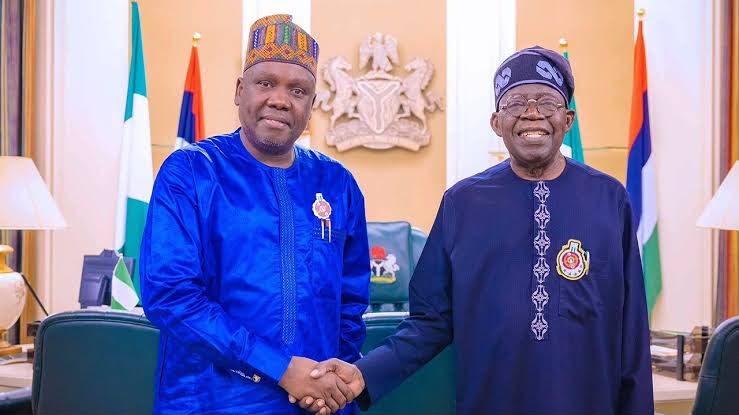
Special Adviser to President Bola Tinubu on Media and Policy Communication, Daniel Bwala, has claimed that Nigeria would have been overrun by terrorists without what he described as the “resolute interventions” of the Tinubu administration.
Bwala said the administration inherited a complex security situation worsened by the spread of terrorist networks across the Sahel, insisting that the government had deployed a combination of military operations, intelligence gathering and international partnerships to contain the threat.
He spoke on Thursday during an interview on Frontline, a current affairs programme on Eagle 102.5 FM, Ilese-Ijebu, Ogun State.
According to him, the movement of terrorist groups across the Sahel had created a regional security threat capable of spilling deeper into Nigeria through the country’s northern borders.
“Were it not for the various interventions of Bola Ahmed Tinubu, Nigeria would have become a sorry state security-wise,” Bwala said.
He argued that the influx of terrorist organisations into the Sahel had added a new dimension to Nigeria’s existing problems involving insurgency, banditry, kidnapping and other forms of organised crime.
Bwala said the groups were attempting to spread their activities across different parts of the country, particularly the North-East and North-West.
“And that is why you see in the North-West and even in the North-East the influx of these terrorists. When they enter the country, they try to spread themselves across different parts of the country,” he said.
The presidential aide maintained that the scale of the threat had forced the government to deploy soldiers for internal security operations, despite the military’s traditional focus on external threats.
He also said Nigeria had strengthened its counter-terrorism cooperation with the United States, which, according to him, had provided additional intelligence and operational capabilities.
“We joined collaboration with the United States government. We are now conducting strikes in Nigeria and killing those people,” he said.
‘Kidnapping has become a crisis economy’
Bwala also described kidnapping and other criminal activities as part of what he called a “crisis economy,” where perpetrators commit crimes primarily for financial gain.
He said the commercialisation of kidnapping had become so entrenched that some individuals allegedly arranged their own abductions to extort relatives or organisations.
“In a crisis economy, people commit crimes to be paid and they want to be paid to stop the crime,” he said.
He argued that the complexity of the situation required the coordinated efforts of the police, intelligence agencies and other security institutions, while the military had increasingly been deployed because of the sophistication and firepower of some criminal groups.
Bwala said Nigeria’s population and vast landmass also placed enormous pressure on its security architecture.
He claimed that the country had fewer than 400,000 soldiers and fewer than 400,000 police officers to secure a population of more than 220 million people, adding that many security personnel had previously been assigned to protect private individuals.
“This is what Bola Ahmed Tinubu came and found,” he said.
Bwala recalled the security situation towards the end of the Muhammadu Buhari administration, citing kidnappings, prison breaks, attacks on security personnel and threats to government institutions.
He said the Tinubu administration had since improved the situation, pointing to what he described as the absence or reduction of prison breaks and the restoration of government presence in major cities.
“What is the situation today? Minimal or no prison break. Abuja is safe. The large part of the major cities in Nigeria are safe,” he said.
However, he acknowledged that insecurity had not been completely eliminated, noting that terrorists and criminal groups still operate in some local government areas and continue to attack vulnerable communities.
He said the government should be assessed not only on individual attacks but also on whether terrorists had succeeded in taking over large territories.
Bwala further claimed that the prosecution of terrorism suspects had improved under the Tinubu administration, including suspects previously returned to Nigeria from the United Arab Emirates.
“Security-wise, we are making the progress,” he said.
On the killings in Benue and Plateau states and the controversy over claims of Christian genocide, Bwala rejected any suggestion that the Federal Government was responsible for attacks against Christians.
He said the government recognised that both Christians and Muslims had been victims of violence but insisted that such killings should not be interpreted as state-sponsored attacks.
“In Nigeria, is the government part of the killing of Christians? That was why we disagreed. We were not saying Christians are not killed. We were not saying Muslims are not killed,” he said.
Bwala said he had also engaged American lawmakers and other international stakeholders to explain the government’s position on Nigeria’s security situation.
He said the engagements had contributed to stronger security cooperation between Nigeria and the United States, including working groups involving officials of both countries.
The presidential aide also took a swipe at opposition politicians, describing them as “desperados” and “content creators” who, according to him, had failed to present Nigerians with an alternative policy direction.
He alleged that opposition parties had spent the past three years criticising the Tinubu administration without explaining what they would do differently if elected.
“The opposition in Nigeria, they are lazy. They don’t have a job. That’s why in the past three years, they have never been able, and up till today, to tell Nigerians one thing that they will do differently from what we are doing,” Bwala said.
He also defended Tinubu’s relationship with governors from opposition parties, citing Bauchi, Anambra and Abia as examples of states where, he claimed, governors had benefited from Federal Government interventions.
Bwala argued that governors would naturally cooperate with a President whose policies benefited their states.
He dismissed claims that Nigeria was drifting towards a one-party state, pointing to the existence of multiple political parties and recent elections.
“Do you know how many parties are registered with INEC? Do you know how many parties are going into the election? The election in Osun, is it a one-party election?” he asked.
The presidential aide also accused opposition figures of lacking clear ideological direction, saying some had struggled to explain the ideology of their political parties.
“These guys are desperados. Leave them. They are just content creators. They are not prepared,” he said.
Bwala, however, said the Federal Government could not shoulder the entire responsibility for Nigeria’s security challenges, urging state governors to do more.
He questioned the position of governors who disclaim responsibility for security while relying on security agencies to protect them during elections and other political activities.
“The truth of the matter is that governors need to do more. A lot of governors are not doing anything,” he said.
He also questioned the use of security votes by state governments, asking whether the funds were producing measurable improvements in public safety.
Bwala said the proposed state police initiative would help decentralise policing and enable security agencies to respond more effectively to local threats.
“That is the crux of the matter. The President is a democrat. That is why we now went ahead to do the State Police Initiative,” he said.
He expressed confidence that the Tinubu administration would continue to pursue reforms aimed at strengthening security and improving governance, while also predicting a stronger role for younger politicians in Nigeria’s future leadership.
“We need a new generation of politicians that will come with ideas,” Bwala said.
He added that the President’s vision was to ensure that younger Nigerians increasingly occupied leadership positions.
Bwala also expressed confidence that Tinubu would secure a second term, declaring that the President would ultimately be remembered as one of Nigeria’s best leaders.
 '
' '
'Do you want to share a story with us? Do you want to advertise with us? Do you need publicity for a product, service, or event? Contact us on WhatsApp +2348183319097 Email: platformtimes@gmail.com
We are committed to impactful investigative journalism for human interest and social justice. Your donation will help us tell more stories. Kindly donate any amount HERE
