

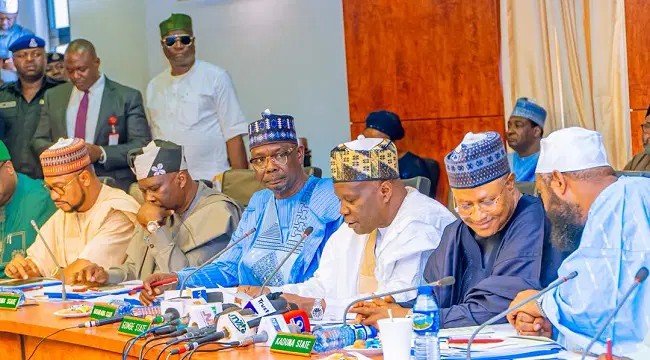
Northern governors and traditional rulers on Monday declared unequivocal support for the immediate establishment of state police, insisting that Nigeria’s centralised policing architecture has become “grossly inadequate” for a nation battling escalating insecurity and a population of more than 200 million people.
Their position was contained in a communiqué issued after a high-level security meeting in Kaduna attended by the governors of the 19 northern states, top traditional rulers, and security stakeholders.
The meeting, hosted by Kaduna State Governor, Senator Uba Sani, and chaired by Gombe State Governor, Inuwa Yahaya, focused on the intensifying security crises—banditry, mass kidnappings, farmer-herder clashes, and economic disruptions—which continue to plague northern communities.
Governor Uba Sani, in a firm opening address, warned that the region can no longer rely on a centralised system that leaves vast territories unprotected.
“Nigeria’s centralised policing model can no longer meet the demands of a nation with over 200 million people and vast ungoverned spaces,” Sani said.
“With fewer than 400,000 police officers nationwide, many rural communities are left without meaningful protection.”
Countering narratives that northern leaders were indifferent to the crisis, Sani said such claims were politically motivated and untrue.
“A few voices driven by political motives have worked to create the impression that northern governors have grown complacent. Nothing could be further from the truth,” he stated.
“We understand the weight of the mandate entrusted to us. We feel the urgency of every threat and every developmental need.”
Sani revealed that governors in the region have created an informal peer review mechanism to share intelligence, evaluate strategies, and adopt successful security interventions across states.
Governor Yahaya reinforced the call for decentralised policing, stressing that the security challenges in the North transcend religious or ethnic boundaries.
“Insecurity today does not discriminate between Muslims and Christians,” he said.
“Every resident of the North is affected. That is why we must unite behind reforms that bring policing closer to the people.”
He praised President Bola Tinubu for “bold steps” to stabilise security nationwide but insisted that only a locally grounded policing system can sustain progress.
Yahaya also urged leaders and commentators to refrain from divisive rhetoric that fuels distrust and aids criminal groups.
“This is not the time for inflammatory statements,” he warned.
“Criminals are exploiting social fractures. We must not assist them by tearing ourselves apart.”
He linked the region’s security challenges to deep-rooted issues—poverty, illiteracy, climate pressures, and decades of underdevelopment—arguing that sustainable peace must involve tackling these structural problems.
“Security is not just about arms and uniforms. It is also about addressing systemic deprivation,” Yahaya said.
Traditional rulers at the meeting threw their weight fully behind state police, describing it as the only effective path to securing rural communities that have become soft targets for bandits and kidnap gangs.
The leaders jointly urged the Federal Government to fast-track constitutional and legislative processes for state policing as part of broader security reforms.
The meeting concluded with a renewed commitment by governors and royal fathers to deepen collaboration, enhance community-level intelligence, and push for a policing structure that responds to local realities.
“The North needs a more adaptive, community-rooted policing model. The time to act is now,” the communiqué stated.
 '
' '
'Do you want to share a story with us? Do you want to advertise with us? Do you need publicity for a product, service, or event? Contact us on WhatsApp +2348183319097 Email: platformtimes@gmail.com
We are committed to impactful investigative journalism for human interest and social justice. Your donation will help us tell more stories. Kindly donate any amount HERE
