

Grace Adeleke
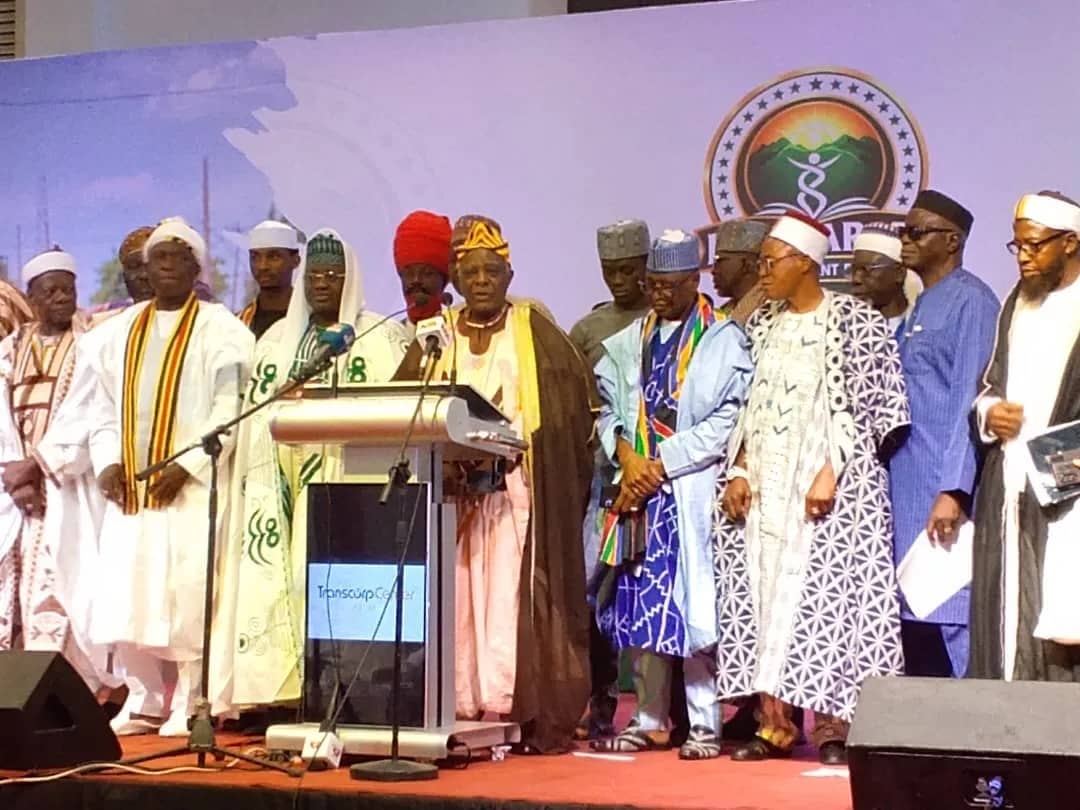
The Aku-Uka of Wukari, Taraba State, Dr Ishaku Adda Ali, has raised the alarm over the worsening security crisis confronting communities linked to the historic Kwararafa Kingdom, saying several communities have been devastated by banditry, kidnapping, farmer-herder violence and displacement.
The monarch spoke at the 2026 Kwararafa People’s Assembly held in Abuja, where he called for urgent and sustained intervention to address the insecurity ravaging communities across parts of Benue, Kogi, Taraba, Southern Kaduna, Nasarawa, Plateau and Niger states.
According to him, the security situation had become so severe that farmers could no longer safely access their farms, traders were struggling to reach markets, while children had been forced out of school.
He said many ancestral homes had also been destroyed, leaving thousands of displaced residents struggling to survive.
“Children can no longer go to school. There are elders whose ancestral homes have been reduced to ashes. We do not come here to accuse, but to say, we need help,” the monarch said.
He added that the assistance required must go beyond official statements and conferences, insisting that interventions must reach communities directly.
“We come here to say that the help must be real, it must be sustained, and it must reach the communities that are suffering, not stop at the level of communiques and conferences,” he said.
The traditional ruler, who is the chief convener of the assembly, also expressed concern over the divisions among communities historically associated with the Kwararafa Confederacy.
He said political, religious and ethnic divisions had weakened relationships among the people, despite their shared historical heritage.
Ali questioned why communities that were historically able to form a political and cultural confederacy centuries ago could not overcome their differences in the 21st century.
“If the Jukun, and the Idoma, Igala, Ebira, Alago, Nupe, Tarok, Angas, Eggon, Mighill, Ohafia, Bekwara, Yala, Gamai and Kare-Kare, among others, could build a common political house in the 15th century, what excuse do we have in the 21st century?” he asked.
He said the assembly was convened to revive the bonds among the diverse peoples associated with the former Kwararafa Confederacy and promote cooperation in addressing contemporary challenges.
According to him, the confederacy historically brought together diverse communities around the Niger-Benue confluence into a political and cultural formation that commanded the respect of neighbouring societies.
The Taraba State Governor, Agbu Kefas, who served as a core convener, said his participation was based on his identity as a descendant of Kwararafa and not in his official capacity as governor.
Kefas stressed that the assembly was neither a Taraba State Government programme nor an avenue for advancing a personal, political or sectional agenda.
“For the avoidance of doubt, my role as a core-convener is not an official responsibility of the Taraba State Government. This assembly is not Taraba State Government programme and it is not intended to advance any personal, political, or sectional agenda,” he said.
The governor said the gathering provided an opportunity for people connected to the Kwararafa heritage to renew their shared vision and consider ways of contributing to Nigeria’s development.
He also commended the Aku-Uka for convening the assembly, stressing that Kwararafa heritage should not be regarded as belonging exclusively to Taraba State, a particular ethnic group or a single traditional institution.
Rather, he said, the heritage belongs to all communities connected to it.
Also speaking, the Ohimegye of Opanda-Umaisha Kingdom, Nasarawa State, HRH Alhaji Usman Abdullahi, said the Ebira people of Nasarawa were among the communities linked to the Kwararafa heritage.
He urged communities associated with the kingdom to preserve and identify with their shared heritage regardless of where they lived.
Abdullahi proposed that symbols representing Kwararafa should be displayed in traditional rulers’ palaces across the affected communities to reinforce the bonds among the people.
“Having Kwararafa symbols in every palace will symbolise that anywhere you go, it will show that this is your brother,” he said.
He also expressed hope that the assembly would produce a communiqué setting out guidelines for future engagements and conferences.
 '
' '
'Do you want to share a story with us? Do you want to advertise with us? Do you need publicity for a product, service, or event? Contact us on WhatsApp +2348183319097 Email: platformtimes@gmail.com
We are committed to impactful investigative journalism for human interest and social justice. Your donation will help us tell more stories. Kindly donate any amount HERE
