

…156 reported dead as Mining Marshals shut 108 sites, arrest 743 suspects — FG
Daud Olatunji
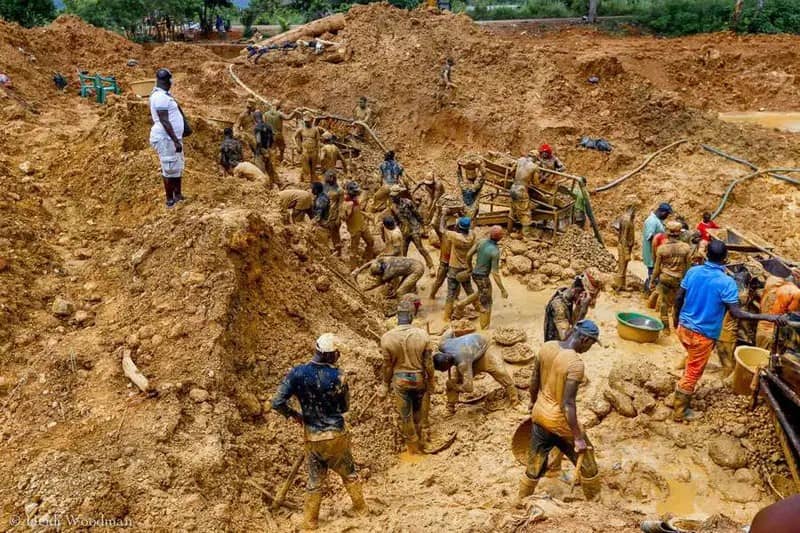
Nigeria’s illegal mining crisis is deepening, with 374 unauthorised mining sites uncovered across 17 states, while at least 156 deaths have been reported in mining-related incidents, highlighting growing concerns over public safety, environmental degradation, child labour and national security.
The development has heightened fears that the country’s vast mineral resources are increasingly being exploited outside regulatory controls, with security agencies and lawmakers warning that illegal mining is no longer merely an economic or environmental offence.
In some parts of the North-West and North-Central, illegal mining has been linked by authorities and security experts to wider security challenges, including banditry, kidnapping and other criminal activities.
The Federal Government has responded with enforcement operations, prosecutions and efforts to formalise artisanal mining, but the persistence of illegal operations suggests that significant gaps remain in regulation and enforcement.
The Minister of Solid Minerals Development, Dele Alake, recently disclosed that the Mining Marshals had identified 374 illegal mining sites, cleared 108, arrested 743 suspects and prosecuted 165 cases involving 430 accused persons, with five convictions secured.
The Mining Marshals, established under the Nigeria Security and Civil Defence Corps, have been deployed to identify and shut illegal sites, arrest suspects and protect licensed mining areas.
But the illegal mining economy extends beyond the miners seen digging pits.
Investigations cited by Sunday Vanguard indicate a complex network involving artisanal miners, labourers, mineral buyers, middlemen, financiers, processors and, in some instances, foreign nationals.
Authorities have repeatedly raised concerns over the involvement of foreign nationals in unauthorised mining and mineral trading.
Alake said in May that more than 327 people, including foreign nationals, had been arrested for illegal mining, while some cases involving suspected links to terrorism were referred to the Office of the National Security Adviser.
The minister also said about 3,000 mining licences had been revoked as part of efforts to sanitise the sector.
Chinese nationals have featured prominently in some recent enforcement operations.
In May, the NSCDC Mining Marshals arraigned 15 Chinese nationals and nine Nigerians before the Federal High Court in Abuja over alleged illegal lithium mining in Kokona Local Government Area of Nasarawa State.
Four Chinese nationals were also arrested in September at Maiya’aki, Lapai Local Government Area of Niger State, over alleged unauthorised mining activities at a site where they reportedly lacked valid licences.
An EFCC court filing has also alleged the involvement of Chinese and Nigerian nationals in the illegal extraction and trading of mica and lithium, with some minerals allegedly moved to Ogun State for processing and export through Lagos.
The allegations are subject to investigation and judicial proceedings where applicable.
Zamfara remains one of the states at the centre of Nigeria’s illegal gold-mining crisis.
Mining activities are particularly prevalent in Maru, Anka, Bukkuyum, Talata Mafara and Zurmi, where many rural residents depend on artisanal mining for their livelihoods.
However, security concerns have intensified where unregulated mining reportedly overlaps with armed groups and weak state control.
An attack in Gobirawar Chali, Maru Local Government Area, in April 2025 reportedly killed at least 19 people, although Amnesty International put the death toll at more than 20.
There have also been allegations that a terror kingpin demanded protection levies from gold miners in Zurmi. The allegation could not be independently verified.
A mining-pit collapse in Kadauri, Maru Local Government Area, in September 2025 also reportedly resulted in casualties.
Beyond the loss of lives, mining has affected farmland and vegetation and raised concerns about the contamination of water sources.
Plateau State has recorded a series of mining-related disasters and violent incidents.
Mining activities are concentrated in Barkin Ladi, Jos South, Bassa, Riyom, Wase, Bokkos and Mangu.
Thirteen people reportedly died following a mining-site collapse around the Bassa-Jos South-Jos North axis in November 2024, while another four died in a collapse at Dura, Jos South, in September 2025.
In February 2026, at least 37 people reportedly died at Kampanin Zurak, Wase Local Government Area, following exposure to toxic gas at a mining site.
Other reported incidents included deaths at Gero Village, Gyel; Nyango-Gyere; Kassa; and Gangare.
The reported incidents put the death toll at about 90 in the state.
Concerned about the situation, Governor Caleb Mutfwang issued Executive Order 001 in February 2025, suspending mining activities across 17 local government areas.
Despite the suspension, authorities have continued to face difficulties monitoring remote and scattered mining locations, particularly amid reports of night operations.
Niger State has also become a major focus of the illegal mining crisis.
Illegal and unauthorised mining activities have been reported in several local government areas, including Lapai, Katcha, Kontagora, Mariga, Minna, Shiroro, Rafi, Suleja, Agwara, Borgu, Munya and Paikoro.
Gold mining is prominent in several areas, while the state also possesses deposits of talc, feldspar, iron ore, beryl, amethyst, tourmaline, graphite, manganese, mica, wolframite, marble, lead, copper and other minerals.
Four Chinese nationals were arrested in September at Maiya’aki, Lapai, over alleged unauthorised mining.
But the state attracted national attention following the deaths of 37 suspected illegal miners while in NSCDC custody.
The circumstances surrounding the deaths remain under investigation, with the Federal Government constituting an independent 10-member committee to investigate the incident.
Taraba, rich in gold, sapphire, topaz, lead, zinc and lithium, has also struggled with unauthorised mining.
Mining activities have been reported in Mayokam and Gangtu in Bali, the Mambilla Plateau, Takum, Ardo-Kola and Gassol, among other locations.
Security reports have raised concerns about migrant labourers and undocumented foreigners operating in some mining camps.
Governor Agbu Kefas has issued three executive orders suspending mining activities since 2023, including another suspension in June 2026.
A mining-pit collapse in Mayokam, Bali Local Government Area, on September 18 reportedly killed five alleged illegal miners.
A Premium Times investigation previously estimated that Taraba could be losing more than N10bn annually to illegal mining.
In Ebonyi, abandoned mining pits have emerged as a major threat to residents.
Mining activities have been reported in Abakaliki, Ikwo, Izzi, Ezza South, Ebonyi and Ishielu.
Communities including Okposi Umuoghara, Enyigba, Ameka and Ishiagu have raised concerns over abandoned pits.
At Okposi Umuoghara, a truck driver and his assistant reportedly died after falling into a mining pit. A motorcycle operator and a cyclist were also reportedly killed in separate incidents involving the same area, bringing the reported deaths to at least five.
The state government has established a Solid Minerals Task Force to seal illegal sites, confiscate equipment and curb unauthorised mining and night-time transportation of minerals.
Osun State is experiencing another dimension of the crisis, with illegal mining threatening farmland, water sources and rural livelihoods.
The problem is particularly pronounced in Osun-East Senatorial District, including parts of Ifeland and Ijesaland.
Communities reportedly affected include Ibodi, Ijanna Wasare, Itagunmodi, Ayegunle, Iwara, Igangan, Kajola, Iponda, Ikinyinwa and Ilase.
Farmers have reportedly abandoned some farmlands because of mining activities, while some residents living close to mining sites have also left their homes.
There have also been allegations that influential individuals and some officials shielded illegal miners through informal ticketing arrangements.
During an inspection visit to Ibodi, allegations emerged of a confrontation involving security personnel and enforcement officers. Some claims surrounding the incident remain allegations and require independent verification.
Concerns have also been raised over pollution of the Osun-Osogbo River.
Urban Alert called for urgent intervention, saying the river serves more than 20 communities and supports a large population across parts of the South-West.
The organisation said testing had detected substances including cyanide, mercury and lead, raising concerns about possible environmental and public-health risks.
The Chairman of Ilesa West Local Government Area, Lanre Balogun, alleged that many mining sites were unregistered and operating without valid licences.
Ogun State has also recorded mining activities in areas including Ogere in Ikenne, Ode-Remo in Remo North and the Omi-Ogunmakin-Odeda axis.
The state is endowed with lithium, mica, gold, tantalite, granite, feldspar, kaolin, silica sand and clay.
The expansion of mining activities has raised concerns over environmental degradation, land use and the regulation of operators working outside the formal licensing framework.
Beyond deaths and environmental destruction, experts warn that children living or working around mining sites face potentially lifelong consequences.
Professor Omoniyi Yemitan, a professor of pharmacology and toxicology at the Lagos State University College of Medicine, said children could be exposed to heavy metals and other harmful substances through air, water and soil.
According to him, prolonged exposure to toxic metals could affect children’s neurological and respiratory development.
He warned that mining environments could expose children to substances such as lead and mercury, which have been associated with serious health consequences.
Children, he noted, are particularly vulnerable because their bodies and organs are still developing.
Dr Casmier Ifeanyi, a public health and medical research scientist and National President of the Association of Medical Laboratory Scientists of Nigeria, similarly warned that the consequences of poorly regulated mining could extend beyond mining communities.
He said contaminated water, soil and food could expose people who had never entered a mining pit.
The health risks, according to him, could include heavy-metal poisoning, developmental problems and long-term illnesses.
The experts also warned that children working at mining sites lose access to education while being exposed to dangerous working conditions.
Ifeanyi said some children were attracted to mining because of the immediate income it offered, potentially creating a cycle in which education was abandoned for hazardous labour.
He also raised concerns about sexual exploitation, early pregnancy and other vulnerabilities around mining communities.
Professor Oladapo Ashiru, a reproductive endocrinologist and pioneer of in-vitro fertilisation in West Africa, warned that exposure to substances such as lead and mercury could also have reproductive-health implications.
He said exposure could affect fertility, pregnancy outcomes and reproductive health, with potential consequences extending to future generations.
Children working at mining sites, he added, could also suffer injuries from pit collapses, heavy loads, unsuitable equipment and exposure to toxic substances.
Security expert, Dr Bamaiyi Altine, urged the government to treat illegal mining as a national security issue, warning that proceeds from illegal mineral exploitation could potentially provide resources for armed groups.
Another security expert, Okwuonye Eziashi, said the government must act before illegal mining develops into a wider security crisis.
He warned that valuable minerals being exploited outside the law could attract criminal networks and deepen insecurity.
The experts called for stronger security around mining communities, tighter regulation, proper monitoring of mineral supply chains and measures to prevent proceeds from illegal mining from financing criminal activities.
Despite the Federal Government’s enforcement efforts, the persistence of illegal mining across multiple states demonstrates the complexity of the challenge.
Mining communities often depend on artisanal mining for livelihoods, meaning that simply shutting down sites without providing lawful alternatives could push operators into other unregulated locations.
Experts therefore called for stronger formalisation of artisanal mining, alternative livelihoods, comprehensive environmental monitoring and better data on mining locations.
Ifeanyi argued that the government should develop a comprehensive digital monitoring system showing the location and status of mining operations across the country.
Such a system, he said, would enable authorities to identify licensed, artisanal and illegal operations and respond more quickly to violations.
Source :Vanguard
 '
' '
'Do you want to share a story with us? Do you want to advertise with us? Do you need publicity for a product, service, or event? Contact us on WhatsApp +2348183319097 Email: platformtimes@gmail.com
We are committed to impactful investigative journalism for human interest and social justice. Your donation will help us tell more stories. Kindly donate any amount HERE
