

Suliat Lawal
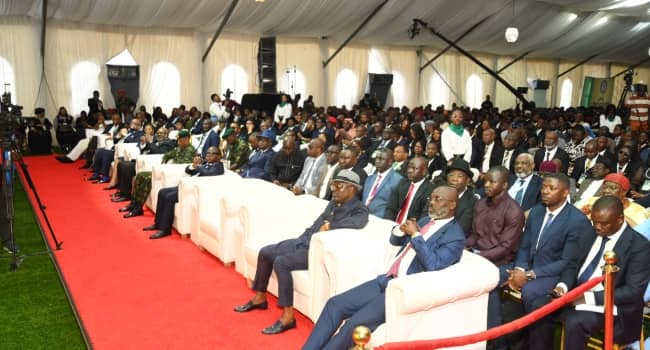
The need to strengthen Nigeria’s democratic institutions, protect judicial independence and restore public confidence in the rule of law dominated proceedings on Saturday as the Nigerian Bar Association’s 2026 Annual General Conference opened in Port Harcourt, Rivers State.
The conference, themed “Beyond Limits,” brought together senior lawyers, judges, political leaders, traditional rulers, security chiefs and other stakeholders to examine the challenges confronting Nigeria’s democracy and justice system.
Declaring the conference open, Rivers State Governor, Siminalayi Fubara, challenged legal practitioners and judges to resist conformity and ensure that the judiciary remains capable of holding governments accountable.
Fubara said courts should not be viewed merely as places where disputes are settled, but as institutions where ordinary citizens could seek protection against injustice.
He urged judges to consider the wider consequences of their decisions on society, stressing that judicial officers must have the courage to act independently.
The governor also assured delegates of their safety throughout the conference and expressed his administration’s readiness to work with the NBA to strengthen the rule of law in Rivers State.
Fubara commended the NBA for returning its annual conference to Port Harcourt following the lifting of the state of emergency imposed on the state.
The association had initially chosen Port Harcourt to host its 2025 conference but abandoned the plan after the declaration of the state of emergency and the appointment of a sole administrator.
The immediate past NBA President, Afam Osigwe, explained that the association had considered it inappropriate to hold its major conference in a state where democratic governance had been suspended.
According to him, the NBA subsequently resolved to return to Port Harcourt once democratic governance was restored.
Speaking on the conference theme, Osigwe expressed concern over Nigeria’s inability to fulfil the aspirations of its founding fathers more than six decades after independence.
He identified tribalism and parochial interests as among the factors undermining national development, but argued that Nigeria still had the capacity to overcome its challenges.
Osigwe urged lawyers to move beyond criticism and provide constructive recommendations capable of helping government improve governance.
He said the legal profession had a responsibility to ensure that justice and the rule of law remained the foundation of society.
Weah: Democracy needs strong institutions
Former Liberian President, George Weah, who delivered the keynote address, warned that democracy could not survive on the strength of individuals alone.
Weah said democratic governance was tested continuously and not only during elections, stressing that strong institutions were essential to protecting citizens’ rights.
He identified an independent judiciary and a fearless legal profession as critical safeguards against democratic erosion.
The former Liberian president warned that threats to democracy could emerge through the weakening of judicial institutions, corruption, manipulation of public budgets and undue pressure on judges.
He said the rule of law should guarantee that citizens’ rights were protected regardless of the individual occupying political office.
“We are Africans not short of brilliance; we’re short of the infrastructure that makes brilliance available to us,” Weah said.
He urged African countries to develop institutions capable of translating the talents and potential of their citizens into sustainable development.
The Chief Justice of Nigeria, Justice Kudirat Kekere-Ekun, represented at the event by the Chief Judge of Nigeria, described the conference theme as an opportunity for the legal profession to examine the limits imposed by professional ethics, institutional structures and emerging technology.
She said the rapid development of artificial intelligence was already creating new questions for both the Bar and the Bench.
Kekere-Ekun disclosed that the Supreme Court had introduced new procedures aimed at modernising the administration of justice, expressing the hope that other courts would adopt similar technological innovations.
She, however, stressed that technological advancement must not come at the expense of judicial independence and professional ethics.
According to her, the ultimate measure of the justice system should be the experience of citizens who approach the courts in search of justice.
NBA must defend citizens, institutions — Shehu
The Shehu of Borno described the legal profession as an important pillar in the protection of citizens and the strengthening of national institutions.
He charged the NBA to continue defending citizens’ rights while contributing to the development of institutions capable of upholding justice and accountability.
The traditional ruler said the law must protect vulnerable citizens and provide mechanisms for resolving disputes without fear or favour.
He also urged young lawyers to view the profession as an avenue for service to humanity rather than merely a means of personal advancement.
Army links security to rule of law
The General Officer Commanding 6 Division, Nigerian Army, Maj. Gen. Everest Okoro, who represented the Chief of Army Staff, said national security extended beyond military operations.
Okoro said a secure Nigeria also required justice, respect for human rights and adherence to the rule of law.
He pledged the Army’s willingness to work with the Bar, Bench and other institutions in pursuit of a more secure and just country.
The President of the Uganda Law Society, Isaac Semakade, also stressed the importance of protecting individual rights, including the right of accused persons to dignity and a fair defence.
The Chief Judge of Rivers State, Justice Simeon Amadi, charged the incoming NBA leadership to surpass the achievements of its predecessors.
Amadi also urged lawyers to embrace technological innovations, particularly artificial intelligence, which he said was rapidly reshaping legal practice.
The conference therefore opened against the backdrop of a common message from speakers: that Nigeria’s democratic future depends less on the strength of individual leaders and more on the independence, integrity and effectiveness of its institutions.
For the legal profession, the challenge before the NBA is not only to defend the rule of law when it is threatened, but to ensure that justice remains accessible to ordinary Nigerians regardless of status or political influence.
 '
' '
'Do you want to share a story with us? Do you want to advertise with us? Do you need publicity for a product, service, or event? Contact us on WhatsApp +2348183319097 Email: platformtimes@gmail.com
We are committed to impactful investigative journalism for human interest and social justice. Your donation will help us tell more stories. Kindly donate any amount HERE
