

...Network unveils action plan, targets host communities, regulators
…CSOs to deploy Kobo-Collect for environmental, safety monitoring
Daud Olatunji
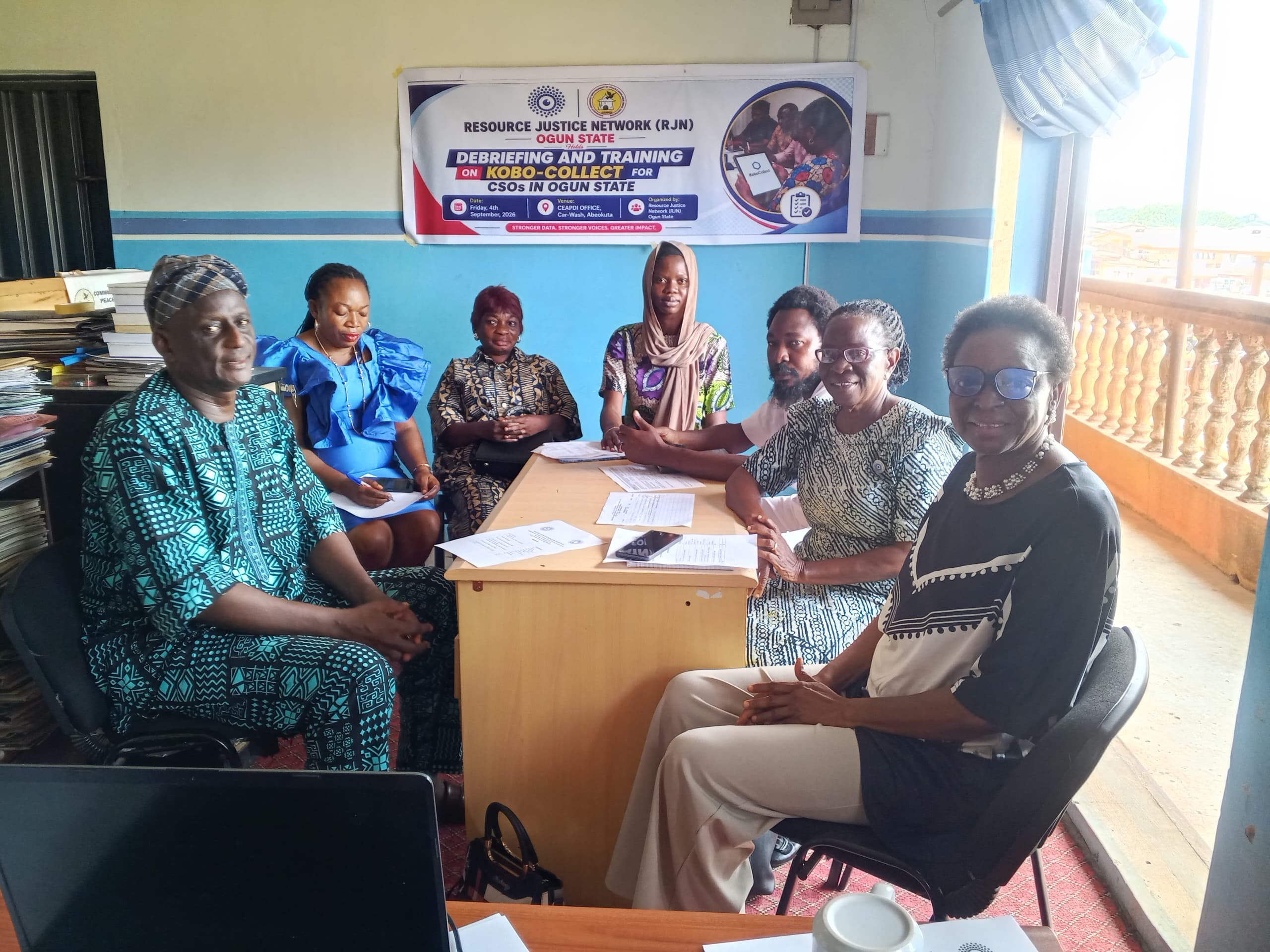
The Resource Justice Network has trained civil society organisations in Ogun State on the use of digital tools to monitor activities and impacts in communities hosting extractive operations.
The training, organised in partnership with the Community Education Advancement of Peace and Development Initiative, was held on Friday at the CEAPDI conference room, Oyebola Shopping Mall, Iyana-Cele, Adatan, Abeokuta.
The programme focused on strengthening the capacity of CSOs to collect, document and report evidence from communities affected by oil, gas and mining activities using Kobo-Collect, a digital data collection platform.
Speaking during the programme, a member of the RJN Board of Trustees, Prof. Temitope Olaifa, who delivered a goodwill message on behalf of the network’s national office, appreciated participants for their commitment to promoting accountability and transparency in the management of natural resources.
Olaifa also explained that RJN was formerly known as Publish What You Pay, noting that the organisation had historically focused on transparency in the environment, mining and extractive sectors.
The National General Secretary of RJN, Prof. Helen Bodunde, said the network had expanded its mandate to address broader questions of social justice, human rights and environmental sustainability.
According to her, the rebranding from Publish What You Pay to Resource Justice Network reflected the organisation’s determination to move beyond financial and revenue transparency to ensuring that communities affected by natural resource extraction benefit from the resources within their environment.
She said communities should not be left to bear the consequences of resource extraction through pollution, health challenges, environmental degradation and destruction of livelihoods.
Bodunde said the network’s approach included anti-corruption campaigns, protection of civic space, gender equity, beneficial ownership transparency and accountability in the face of the global energy transition.
She said, “The Resource Justice Network advocates for just, inclusive and equitable governance of the planet’s natural resources.”
Bodunde added that the network was committed to promoting transparency, accountability and citizen participation in the management of oil, gas and mining revenues.
The Ogun State Coordinator of RJN, Adesina Adefolahan, subsequently presented the network’s action plan for the remainder of 2026.
The plan includes follow-up assessments of RJN members in Ogun, community sensitisation and media engagement, five advocacy meetings with leaders of host communities, dissemination of the Nigeria Extractive Industries Transparency Initiative Financial, Audit and Sectoral Data (NEITI-FASD) Report and at least two media engagements on resource justice in the state.
The network also plans to conduct further debriefing and Kobo-Collect training for CSOs as part of its monitoring activities.
Adefolahan explained that community monitoring would involve citizens independently monitoring oil, gas and mining operations, tracking the effects of extractive activities and creating a bridge among host communities, companies and regulators.
He said community monitors would play important roles in environmental monitoring, safety surveillance, data collection and reporting.
Their responsibilities, according to him, could include monitoring air and water quality, identifying hazards, assessing structural safety, issuing emergency alerts and documenting environmental and other impacts of extractive activities.
Adefolahan said prospective community monitors were expected to possess basic literacy, the ability to use mobile technology and a commitment to neutrality.
He identified participation and inclusiveness, neutrality and credibility, technology and data ethics, human rights and environmental justice as some of the core competencies required of community monitors.
Other skills, he said, included knowledge of technical monitoring tools, extractive-sector governance frameworks such as the NEITI Act and Petroleum Industry Act, environmental impact assessment regulations, conflict resolution, field safety, data ethics, conflict-sensitive negotiation and labour laws.
Participants were thereafter taken through a practical, step-by-step session on Kobo-Collect.
The CSO representatives were taught how to access the digital forms, enter field information, complete questionnaires and submit collected data electronically.
The practical session was designed to improve the ability of CSOs and community monitors to generate credible field data that can be used for advocacy, engagement with regulators and evidence-based reporting.
At the end of the meeting, members of the RJN network in Ogun resolved to commence implementation of the action plan by paying advocacy visits to two traditional rulers in host communities in the state in September 2026.
The proposed visits are expected to strengthen engagement with traditional institutions and deepen community participation in monitoring resource extraction and its impact on host communities.

 '
' '
'Do you want to share a story with us? Do you want to advertise with us? Do you need publicity for a product, service, or event? Contact us on WhatsApp +2348183319097 Email: platformtimes@gmail.com
We are committed to impactful investigative journalism for human interest and social justice. Your donation will help us tell more stories. Kindly donate any amount HERE
