

Zainab Abioye
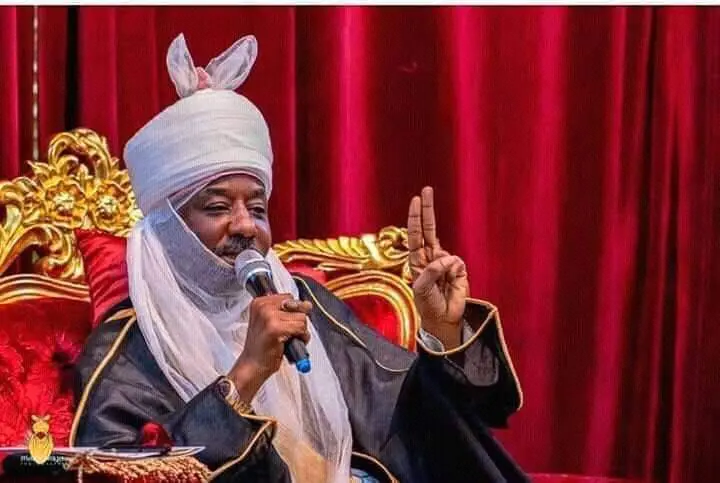
The Emir of Kano, Muhammadu Sanusi II, has identified the politicisation of ethnicity and religion as one of the factors that created an environment in which Boko Haram, banditry and other violent criminal activities could flourish in Nigeria.
Sanusi made the observation on Wednesday in Abuja while speaking at the launch of a book documenting the tenure of former Chief of Army Staff, Lt. Gen. Tukur Buratai (retd.).
The former Governor of the Central Bank of Nigeria argued that Nigeria’s security crisis should not be viewed solely through the prism of the violence that became prominent with the emergence of Boko Haram and other armed groups.
Rather, he said the crisis had deeper roots in years of divisive political rhetoric and the increasing tendency of political actors to define Nigerians according to ethnic, regional and religious identities.
Sanusi said, “The fundamental point I wish to emphasise is that the security crisis in this nation did not commence with violence as we currently witness it, nor did it commence with banditry. It did not commence with Boko Haram and terrorism.
“It originated with the violence inherent in language that appeared in newspapers and emanated from political discourse, wherein we commenced categorising ourselves not as Nigerians, but as Northerners and Southerners, Muslims and Christians, Yoruba and Igbo and Hausa.”
According to him, such divisions helped to create conditions in which violent movements and criminal interests could gain traction.
The monarch warned that unless Nigeria’s political elite deliberately moved away from the politicisation of ethnicity and religion, the country risked reproducing the conditions that fuel insecurity.
Sanusi said, “We are only laying the foundation for a new round of violence. We have to go back to seeing ourselves as Nigerians, as people committed to this country, and focus on what is important, which is the development of our people.”
He called on politicians to concentrate on delivering good governance rather than using religion as a political instrument.
“It is not the responsibility of politicians to give us religion. They are there to give us education, to give us healthcare, to give us an economy and allow the religion to be in the hands of those who are religious leaders,” he said.
The Emir also urged religious leaders to maintain an appropriate distance from partisan politics, arguing that excessive political alignment could weaken their ability to hold political authorities accountable.
“It is also not the duty of religious leaders to get into politics. Right now, there is no distinction between imams and bishops and senators and how everybody is a politician,” he stated.
Sanusi further warned that the politicisation of institutions could undermine long-term national planning.
He noted that institutions such as the military, police and Central Bank needed to plan beyond electoral cycles, unlike elected politicians whose mandates generally run for four years.
“We cannot have a country that we want because we need to have those institutions who are not there on elections. The Army cannot think in four-year cycles. The police cannot think in four-year cycles. The Central Bank cannot think in four-year cycles.
“We have to think 20 years, 30 years, 50 years, whereas elected officers are thinking in four-year cycles,” he said.
Also speaking at the event, Lt. Gen. Domenico Giani (retd.), former Inspector General of the Corpo della Gendarmeria, the police and security force of Vatican City, said the emergence and persistence of Boko Haram should be examined against the backdrop of poverty, distrust and inadequate public services in the North-East.
Giani said Boko Haram did not suddenly emerge in 2015, noting that its roots could be traced to conditions in the North-East during the early 2000s.
“Boko Haram was not born in 2015. Its roots lie in the poverty and distrust of the early 2000s North-East. After Yusuf’s death in 2009, it hardened under Shekau. Chibok in 2014 revealed what Borno, Yobe and Adamawa had endured. By 2016, it had split into JAS and ISWAP, fragmented, mobile, adaptive,” he said.
He stressed that military operations alone could not permanently eliminate the conditions that allow violent organisations to emerge.
“A terrorist organisation that changes form must be met by a state that learns faster than its enemy. Intelligence and regional cooperation are essential, but so are schools, justice and opportunity. If the state arrives with weapons but not services, the vacuum returns,” Giani stated.
 '
' '
'Do you want to share a story with us? Do you want to advertise with us? Do you need publicity for a product, service, or event? Contact us on WhatsApp +2348183319097 Email: platformtimes@gmail.com
We are committed to impactful investigative journalism for human interest and social justice. Your donation will help us tell more stories. Kindly donate any amount HERE
