

Daud Olatunji
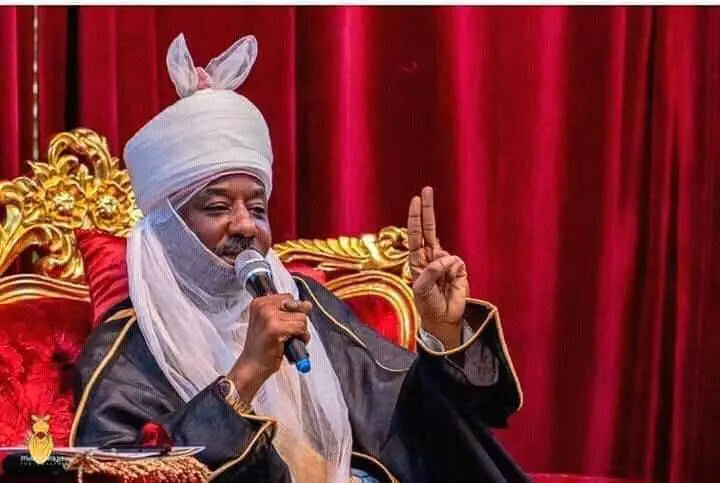
The Emir of Kano, Muhammadu Sanusi II, has criticised President Bola Tinubu’s administration for treating constructive suggestions and criticisms as attacks, accusing the Federal Government of failing to communicate its policies effectively and appoint competent spokespersons.
Sanusi warned that the government’s poor communication strategy was undermining public understanding of its economic reforms, arguing that rather than engage with legitimate concerns, the administration often interprets differing opinions as attempts to discredit it.
The former Governor of the Central Bank of Nigeria made the remarks on Tuesday while speaking at the Oxford Global Think Tank conference convened by former Director-General of the Securities and Exchange Commission, Arunma Oteh.
He said the administration had failed to build an effective communication structure capable of explaining its policies, addressing public concerns and winning citizens’ confidence.
“The government itself does not express itself properly. It sees every suggestion, every contribution that it does not like as an attack on the government and it frankly has not focused on getting very good spokespersons,” Sanusi said.
Despite his criticism, the Kano monarch acknowledged improvements in some key economic indicators under Tinubu, insisting that the administration deserved credit for reversing what he described as the country’s declining economic fortunes.
He cited Nigeria’s second-quarter 2026 Gross Domestic Product growth of 4.48 per cent, describing it as significant progress compared with the country’s economic performance under former President Muhammadu Buhari.
According to him, although the current growth rate remains below the six to seven per cent recorded during the administrations of former Presidents Umaru Musa Yar’Adua and Goodluck Jonathan, it represents an improvement on the average growth achieved under Buhari.
Sanusi said Nigeria’s economy recorded average growth of 0.9 per cent during Buhari’s administration, rising to 1.8 per cent when the COVID-19 pandemic years were excluded.
“Today, it’s at 4.5 per cent. So we have to accept that as progress,” he said.
The former CBN governor also identified the decline in inflation to 14.6 per cent from above 30 per cent in previous years as another positive development, projecting that the rate could drop further to 12.5 per cent next year.
Although he acknowledged that the government’s monetary tightening measures had imposed significant hardship on businesses and households, he maintained that the moderation in inflation was a welcome development.
Sanusi further disclosed that Nigeria’s GDP per capita, measured in dollar terms, had increased by 47 per cent since 2023, attributing the improvement to economic growth and the appreciation of the naira.
He projected that if the trend continued, the country’s GDP per capita could return to its 2005 level by the end of 2027.
On the country’s external reserves, the monarch said Nigeria’s foreign reserves had risen to approximately $55bn, but cautioned that a substantial portion of the increase was driven by foreign portfolio investments, which could quickly leave the country in response to geopolitical tensions or economic shocks.
He attributed part of the foreign investment inflows to higher oil prices amid the conflict around the Strait of Hormuz and attractive returns in Nigeria’s financial markets.
Sanusi also highlighted the contribution of the Dangote Petroleum Refinery to the country’s export earnings, claiming that the facility accounted for approximately 20 per cent of Nigeria’s exports.
He said the refinery exported about 50 per cent of its diesel production and 85 per cent of its aviation fuel, contributing approximately $4bn to Nigeria’s exports in the second quarter of 2026.
According to him, the developments indicated that Nigeria was gradually laying the foundation for economic stability and diversification.
“There are, in terms of the top-line figures, clearly a foundation being laid for stability. And I always say that it is not the end. It is a foundation. It is a first step,” he said.
However, Sanusi warned that the government could not claim meaningful economic success by relying solely on improved macroeconomic indicators while millions of Nigerians continued to grapple with poverty, hunger and the rising cost of living.
He argued that the ultimate measure of the reforms should be their impact on ordinary citizens, particularly low-income households bearing the greatest burden of the government’s economic policies.
The monarch questioned the state of education, healthcare, maternal health and nutrition, insisting that the government must pay greater attention to the living conditions of vulnerable Nigerians.
“At the end of the day, we’ve got to look at the human beings at the bottom of the pyramid. What’s happening to human beings? What’s happening to education? What’s happening to healthcare? What’s happening to maternal mortality? What’s happening to malnutrition? What is happening to hunger?” he asked.
He warned that poverty was rising in some parts of the country even as it declined in others, adding that some Nigerians had been pushed below the poverty line by the economic reforms.
The former CBN governor particularly faulted the Federal Government for failing to establish adequate social safety nets to cushion the effects of its policies on vulnerable households.
He said the administration ought to have anticipated the hardship that would accompany the removal of economic distortions and other reforms and put in place effective intervention programmes to protect poor Nigerians.
“Obviously, when we started these reforms, we should have known that there was going to be an impact on people at the bottom of the pyramid. We should have designed policies that will try to minimise those shocks,” he said.
Sanusi described the failure to adequately protect vulnerable citizens as a major weakness of the government’s economic reform programme, insisting that the problem remained unresolved.
“That is a problem that we’ve not done, and we still have not done,” he added.
He called for significantly higher economic growth and sustained macroeconomic stability, stressing that the government must ensure that the benefits and burdens of its policies were fairly distributed among Nigerians.
Despite his reservations about the administration’s handling of the economy and communication strategy, Sanusi maintained that its efforts to reverse the country’s economic decline deserved recognition.
“I’m not a fan of politicians, but we’ve got to give credit to the administration for bringing us back from the brink,” he said.
 '
 '
Do you want to share a story with us? Do you want to advertise with us? Do you need publicity for a product, service, or event? Contact us on WhatsApp +2348183319097 Email: platformtimes@gmail.com
We are committed to impactful investigative journalism for human interest and social justice. Your donation will help us tell more stories. Kindly donate any amount HERE
 '
