

Daud Olatunji
Disability advocates, journalists and fact-checkers have raised concerns over the inaccessibility of election information and fact-checking tools to persons with disabilities, warning that the gap is exposing millions of Nigerians with disabilities to misinformation and limiting their participation in the country’s democratic process.
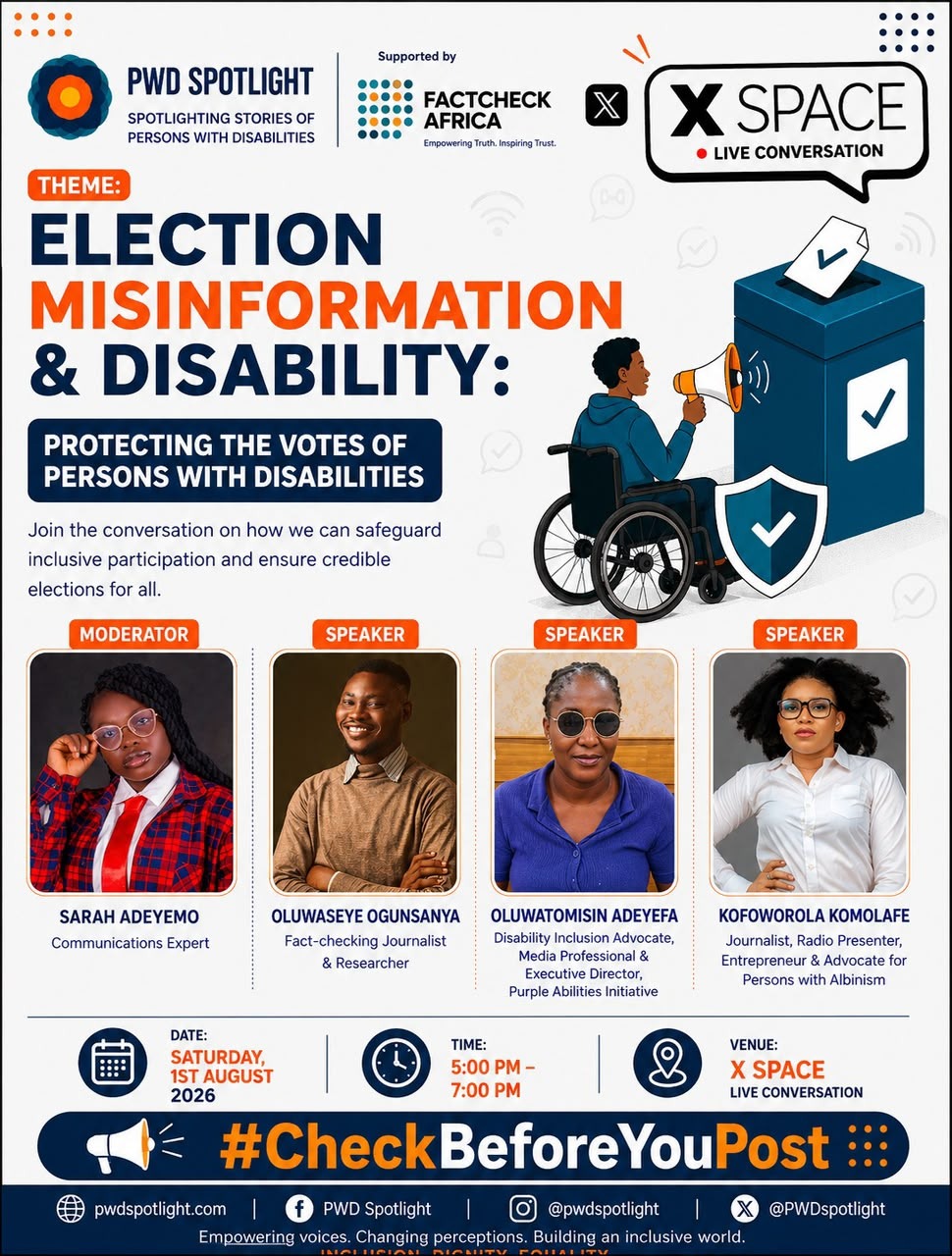
The stakeholders made the call during the maiden edition of PWD Spotlight’s X Space, themed “Election Misinformation & Disability: Protecting the Votes of Persons with Disabilities,” held on Saturday and monitored by PLATFORM TIMES
The virtual forum brought together disability rights advocates, communications professionals and media experts who examined how misinformation disproportionately affects persons with disabilities before, during and after elections.
Participants argued that unless accessibility becomes a central pillar of information integrity, efforts to combat fake news would continue to exclude one of the country’s most vulnerable populations.
A fact-checking journalist and researcher with FactCheckAfrica, Oluwaseye Ogunsanya, said governments, election management bodies, media organisations and civil society groups must work closely with organisations representing persons with disabilities to ensure that no one is left behind.
According to him, collaboration remains one of the most effective strategies for improving access to credible election information.
“One thing that will go a long way towards solving the issue of leaving people behind is collaboration. We cannot overemphasise the place of collaboration,” Ogunsanya said.
“Whenever government is making a decision, it should include these representatives in the decision-making process so that the interests of persons with disabilities are considered.”
Ogunsanya noted that although Nigeria already has policies guaranteeing accessible elections through the Independent National Electoral Commission’s Framework on Access and Participation of Persons with Disabilities, implementation remains the biggest challenge.
He urged authorities to deliberately integrate accessibility into election planning instead of treating disability inclusion as an afterthought.
Speaking on inclusive communication, Ogunsanya stressed that making information accessible goes beyond translating materials into Braille.
“We must consider that diversity when making information available.”
He added that election information should be disseminated through multiple accessible formats, including sign language interpretation, captions, audio versions and easy-to-read materials to accommodate people with different forms of disabilities.
Ogunsanya also encouraged persons with disabilities to verify suspicious election claims through trusted fact-checking organisations and credible sources.
“Because of their particular needs, I would also advise persons with disabilities to rely on and follow fact-checking organisations,” he said.
“They should also ask questions. They should follow their curiosity whenever a story does not seem right.”
He recommended practical verification techniques such as Google Reverse Image Search but admitted that most existing digital verification tools remain inaccessible to persons with disabilities.
“I have not really come across fact-checking tools that are fully accessible to persons with disabilities,” he said, urging media organisations and technology developers to build accessibility into future verification platforms.
Ogunsanya further criticised what he described as the lack of intentionality in government communication with disability communities.
“When government wants to announce an empowerment programme or distribute something such as rice, it knows how to get the information to persons with disabilities. Yet election information does not reach them in the same way,” he said.
“Providing for persons with disabilities requires intentionality.”
Also speaking, the Executive Director of Purple Abilities Initiative, Oluwatomisin Adeyefa, cautioned against assuming that a single communication format could serve every disability community.
She said “”Making information available means providing it in diverse formats. For instance, I am a blind person, and I am not a fan of reading Braille. What about someone who does not know how to read Braille?”.
She explained that disability groups are highly diverse, noting that not all visually impaired persons read Braille and that educational backgrounds differ widely.
Adeyefa maintained that verified election information should therefore be distributed through multiple accessible channels while leveraging organisations of persons with disabilities as trusted platforms for dissemination.
A journalist, radio presenter and advocate for persons with albinism, Kofoworola Komolafe, recounted her personal experience of being discouraged from voting after struggling to locate her polling unit and receiving dismissive treatment from an election official.
She said the incident reflected how inaccessible information and negative institutional attitudes continue to discourage persons with disabilities from participating fully in elections.
The discussion also exposed what participants described as a major gap within the country’s information integrity ecosystem.
A guest journalist and PLATFORM TIMES Editor, Daud Olatunji, questioned whether visually impaired persons could realistically navigate technical verification processes such as reverse image searches without additional support, urging technology developers and media organisations to prioritise accessible verification technologies.
Throughout the session, speakers agreed that disability organisations possess a better understanding of the communication preferences and accessibility needs of their members, making them indispensable partners for governments, election stakeholders and fact-checking organisations.
The moderator announced that PWD Spotlight would sustain the engagement through future public dialogues and practical training programmes aimed at equipping persons with disabilities with digital verification skills and strengthening their participation in elections and public life.
Participants concluded that safeguarding electoral integrity extends beyond debunking falsehoods.
According to them, democracy can only be truly inclusive when every citizen, including persons with disabilities, can access, understand, verify and trust the information needed to participate meaningfully in the electoral process.
 '
' '
'Do you want to share a story with us? Do you want to advertise with us? Do you need publicity for a product, service, or event? Contact us on WhatsApp +2348183319097 Email: platformtimes@gmail.com
We are committed to impactful investigative journalism for human interest and social justice. Your donation will help us tell more stories. Kindly donate any amount HERE
