

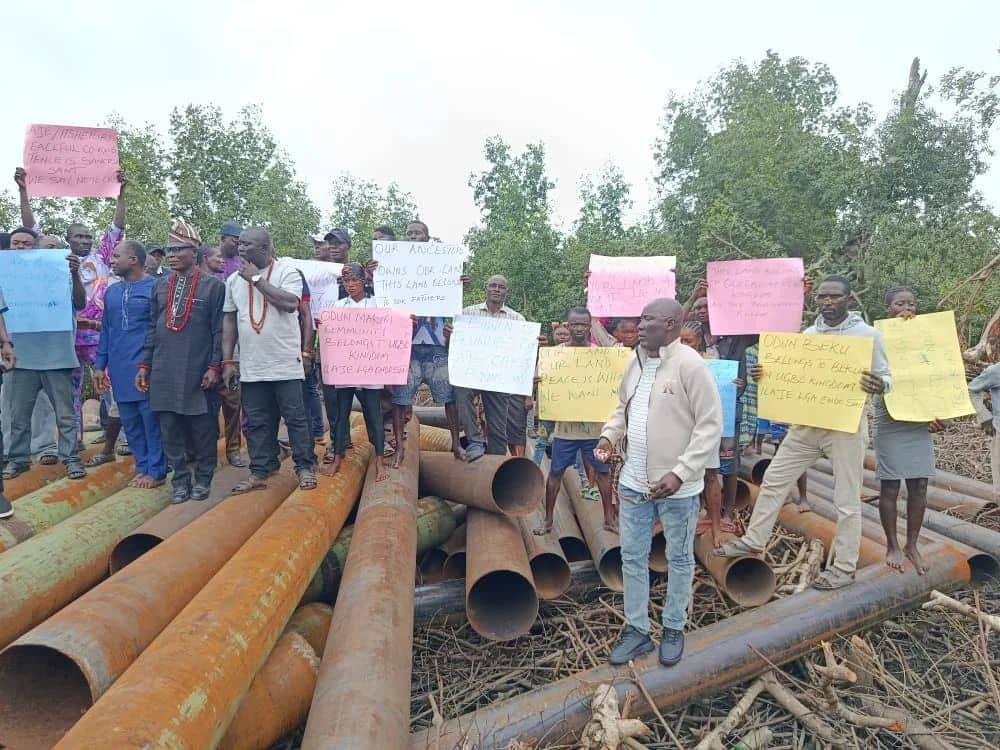
Residents of 19 oil-producing communities in the Ilaje Local Government Area of Ondo State have protested alleged encroachment on their ancestral lands by neighbouring communities in Delta State, warning that the dispute could escalate into an interstate crisis.
The protesters, who took to the streets on Friday, urged the Ondo State Government to urgently intervene in the dispute and strengthen its presence in the affected riverine communities.
The communities, which are said to be part of the Ugbo Kingdom in Ilaje, include Odun Ebiwon, Odun Makin, Ilu Titun, Odun Odunjo, Odun Maha, Eke Nla, Eke Kekere, Ubajakere, Eke Itiola and Odun Okoro.
Others are Odun Yonren, Odun Beku, Odun Ogungbeje, Odun Oyinbo, Odun Oriretan, Ubale Kekere, Ubale Nla, Ikuyinminu and Odun Igo.
The protesters, carrying placards and singing solidarity songs, expressed opposition to what they described as attempts to lay claim to their ancestral territories.
Some of the inscriptions on the placards read: “Odun Makin Community belongs to Ugbo in Ilaje LGA, Ondo State,” “We Don’t Want Crisis in Our Land,” “Oretan Community belongs to Ugbo Kingdom in Ondo State,” “Ilaje People Are Peace-Loving, We Say No to Inter-State Crisis,” and “Ebiwon Community is Ondo State.”
Speaking on behalf of the affected communities, a community leader, Busayo Ebiniyi, said the dispute had become increasingly worrying because of the economic importance of the area, which he described as rich in oil and other mineral resources.
Ebiniyi said the communities had maintained peaceful relations with their neighbours for generations but warned that the alleged encroachment could threaten the existing peace.
He said, “Because of the mineral resources found in our communities in Ugbo Kingdom, Ilaje Local Government, this development has come to threaten the peace of our people.
“This land is our collective patrimony and heritage. We will therefore avoid being intimidated and suppressed by those we consider to be friends but who might have ulterior motives while we embrace peace.”
The community leader said local representatives had been engaging relevant authorities and traditional institutions to prevent the disagreement from degenerating into violence.
He added, “We are communicating with the Delta State Government through the Ondo State Government that we do not want Delta people to return to our community.”
Another community leader, Ebiwonjumi Olumide, insisted that the affected communities had historically been part of Ugbo Kingdom under the authority of the Olugbo of Ugbo.
Olumide said the communities had never identified with Delta State, adding that residents possessed historical and political records which, according to him, supported their claim to the territory.
“We have evidence and proof. We possess historical records and political evidence that support our ownership of this land,” he said.
He cited projects executed by the Ondo State Oil Producing Areas Development Commission between 1999 and 2003, as well as infrastructure constructed under former governors Olusegun Agagu and Olusegun Mimiko, as evidence of the state’s longstanding presence in the communities.
Also speaking, another community leader, Orimisan Ebiwanjuwon, called for increased government presence in the riverine areas through infrastructure, security and social services.
He urged the state government to erect clear boundary signs to reinforce the identity of the communities and prevent further disputes.
“We want the government to put up border signs for Ondo State in this area. We require hospitals, new houses, drinkable water, and sufficient security,” Ebiwanjuwon said.
The protesters maintained that their demand was not intended to provoke conflict but to draw government attention to the alleged encroachment and prevent the dispute from becoming a wider security challenge.
Responding to the development, the Ondo State Commissioner for Information and Orientation, Idowu Ajanaku, said the state government would investigate the allegations.
“The government would investigate the issue. We will make sure that our people continue to live in peace,” the commissioner said.
The development comes amid renewed calls by the affected communities for the government to pay greater attention to the security and development of Ondo’s coastal settlements, particularly areas with significant economic and natural-resource interests.
With the communities insisting that they want peace rather than confrontation, stakeholders are expected to rely on historical records, administrative documents and relevant government authorities to establish the facts and prevent the land dispute from escalating into an interstate conflict.
 '
' '
'Do you want to share a story with us? Do you want to advertise with us? Do you need publicity for a product, service, or event? Contact us on WhatsApp +2348183319097 Email: platformtimes@gmail.com
We are committed to impactful investigative journalism for human interest and social justice. Your donation will help us tell more stories. Kindly donate any amount HERE
