

Daud Olatunji
The Independent National Electoral Commission has declared that artificial intelligence will not be allowed to determine the outcome of Nigeria’s 2027 general elections, insisting that the power to elect political leaders rests exclusively with the electorate.
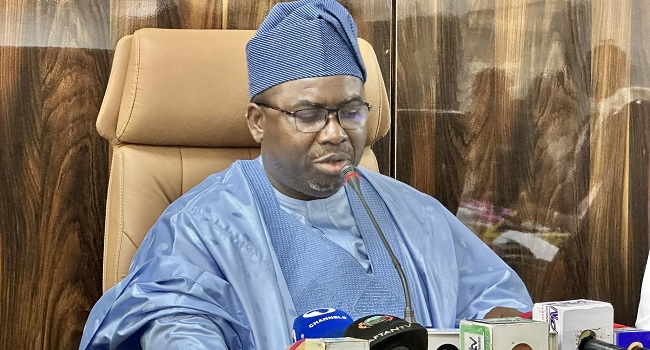
INEC Chairman, Prof. Joash Amupitan, gave the assurance on Wednesday in Abuja while delivering a keynote address at the 2026 AI and Democracy Forum, organised by Yiaga Africa in partnership with INEC, Microsoft, TikTok, the Centre for Journalism Innovation and Development, Dataphyte and other development partners.
Amupitan said although artificial intelligence would increasingly influence election administration, information dissemination and political engagement, the technology must not replace the will of voters or undermine democratic institutions.
“Will algorithms decide the 2027 votes?” the INEC chairman asked rhetorically.
Answering the question, he declared, “No, algorithms will not and must never decide the 2027 vote. The 2027 votes must be decided by the sovereign people of Nigeria.”
The two-day forum, themed ‘Safeguarding the 2027 General Elections in the Age of Artificial Intelligence,’ brought together representatives of electoral commissions from Senegal, Kenya, The Gambia, Liberia, Sierra Leone and Togo, alongside security agencies, civil society organisations, media professionals, technology companies and students.
Amupitan said the gathering was designed to move discussions about artificial intelligence beyond identifying potential dangers to developing practical measures to protect Nigeria’s electoral process.
He noted that AI was already transforming the information environment in which voters made political choices, while creating new opportunities and challenges for electoral administrators.
“AI will undeniably shape the information environment in which citizens form their choices, influence the speed and security of electoral logistics, and alter the tactics of both democratic actors and anti-democratic actors,” he said.
The INEC chairman urged stakeholders to ensure that the technology strengthened democratic institutions rather than created new avenues for electoral manipulation.
“Our task, therefore, at this forum and within the commission, is to ensure that AI remains a servant of democracy, not its master,” he added.
Amupitan said the scale and complexity of Nigeria’s elections made the responsible deployment of technology increasingly necessary.
He disclosed that INEC was preparing to conduct elections involving more than 100 million registered voters across 176,846 polling units in the 36 states and the Federal Capital Territory.
He said the exercise would require the movement of personnel and sensitive election materials across 774 local government areas, including remote communities, riverine settlements and locations affected by insecurity.
To illustrate the logistical challenges, the INEC chairman cited Kabi Ward in Kuje Area Council of the FCT, where reaching some locations could take about three hours, with limited network coverage.
According to him, artificial intelligence could help address such difficulties through predictive modelling, geospatial analysis and dynamic routing.
He explained that machine-learning systems could analyse traffic patterns, weather forecasts, road conditions and security incidents to identify suitable routes for transporting election materials.
“Machine learning algorithms can analyse historical traffic patterns, weather forecasts, road conditions and security incidents to generate optimal deployment routes for logistic vehicles across the terrains,” he said.
Amupitan added that AI-powered systems could also help the commission forecast demand for non-sensitive materials, monitor warehouse inventories and identify supply-chain disruptions before they affected election-day operations.
He said INEC had tested some of the systems during elections conducted since he assumed office, reporting improvements in the early deployment of election materials and the commencement of voting.
The commission also plans to leverage emerging technologies in voter registration, candidate nomination, results management and the maintenance of the national voters’ register.
Amupitan disclosed that INEC had digitised candidate nominations through its Candidate Nomination Portal, which he said had processed more than 15,000 nominations submitted by 22 political parties ahead of the 2027 elections.
He also highlighted the introduction of online voter registration, which allows eligible Nigerians to begin the registration process remotely using digital devices.
According to him, the commission has experimented with downloadable voter cards, including during the Osun governorship election, to assist voters whose cards were lost or damaged and who could not obtain replacements before the poll.
On results management, Amupitan said AI could help identify mathematical inconsistencies, unusual result patterns and image-quality problems in polling-unit result sheets uploaded to the commission’s results management system.
He, however, stressed that such applications would serve as additional safeguards rather than replacements for human supervision and the statutory procedures governing the declaration of election results.
The INEC chairman also said AI-enhanced biometric identification systems could help identify duplicate records in the national voters’ register.
“With over 13 million records in our national register of voters, AI-enhanced automated biometric identification systems drastically accelerate deduplication processes, detecting facial and fingerprint duplicates with unprecedented speed and accuracy,” he said.
Amupitan disclosed that INEC had established an artificial intelligence unit within its Information and Communication Technology department to coordinate the commission’s deployment of the technology.
He said the commission was also finalising a governance framework for AI use in elections, with support from the International Foundation for Electoral Systems and other partners.
The proposed framework, he explained, would be guided by integrity, transparency, human intervention and public auditing.
He warned that while AI could improve election administration, it could also be exploited by malicious actors to attack digital infrastructure, manipulate information and undermine public confidence in the electoral process.
According to him, INEC’s digital platforms, including its results management and candidate nomination systems, could become targets of cyberattacks.
“Every day we check, working with experts in this area, to detect faults and threats to our systems,” he said.
He added that AI-powered cybersecurity tools could help detect and respond to denial-of-service attacks, brute-force attacks and other threats to the commission’s digital infrastructure.
Meanwhile, the Executive Director of Yiaga Africa, Samson Itodo, identified public distrust as one of the major challenges facing Nigeria’s electoral process ahead of the 2027 general elections.
Itodo said concerns about the credibility of elections remained significant, partly because of the controversy surrounding the deployment of technology during the 2023 general elections.
He disclosed that a voting-intention survey conducted by the organisation had highlighted Nigerians’ doubts about the credibility of the electoral process and whether their votes would count in 2027.
“Just last week, Yiaga Africa issued a national voting intention survey report, where it is obvious that Nigerians doubt the credibility of the process, and that their votes will not count in 2027,” he said.
He argued that the deployment of technology alone would not guarantee credible elections, stressing that the integrity of the people responsible for managing electoral systems was equally important.
“It is one thing to deploy technology; it is another thing for the personal integrity of those managing those technologies to deliver,” Itodo said.
The Yiaga Africa chief also expressed concern about the growing number of AI-powered platforms being developed to aggregate election results ahead of the 2027 polls.
He clarified that while independent organisations could aggregate results for monitoring, research and oversight, INEC remained the legally authorised body responsible for declaring election results and winners.
“We encourage stakeholders to continue to use different tools and platforms to keep an eye on the results process,” he said.
Itodo urged organisations deploying AI for election-result aggregation to ensure that their methodologies were transparent, accurate and open to independent scrutiny.
He warned that opaque systems could fuel suspicion, deepen political tensions and undermine confidence in the electoral process.
The forum is expected to produce practical recommendations on regulating and deploying artificial intelligence in Nigeria’s electoral system ahead of the 2027 general elections.
The presidential and National Assembly elections are scheduled for January 16, 2027, while governorship and state House of Assembly elections are slated for February 6, 2027.
 '
' '
'Do you want to share a story with us? Do you want to advertise with us? Do you need publicity for a product, service, or event? Contact us on WhatsApp +2348183319097 Email: platformtimes@gmail.com
We are committed to impactful investigative journalism for human interest and social justice. Your donation will help us tell more stories. Kindly donate any amount HERE
 '
'