

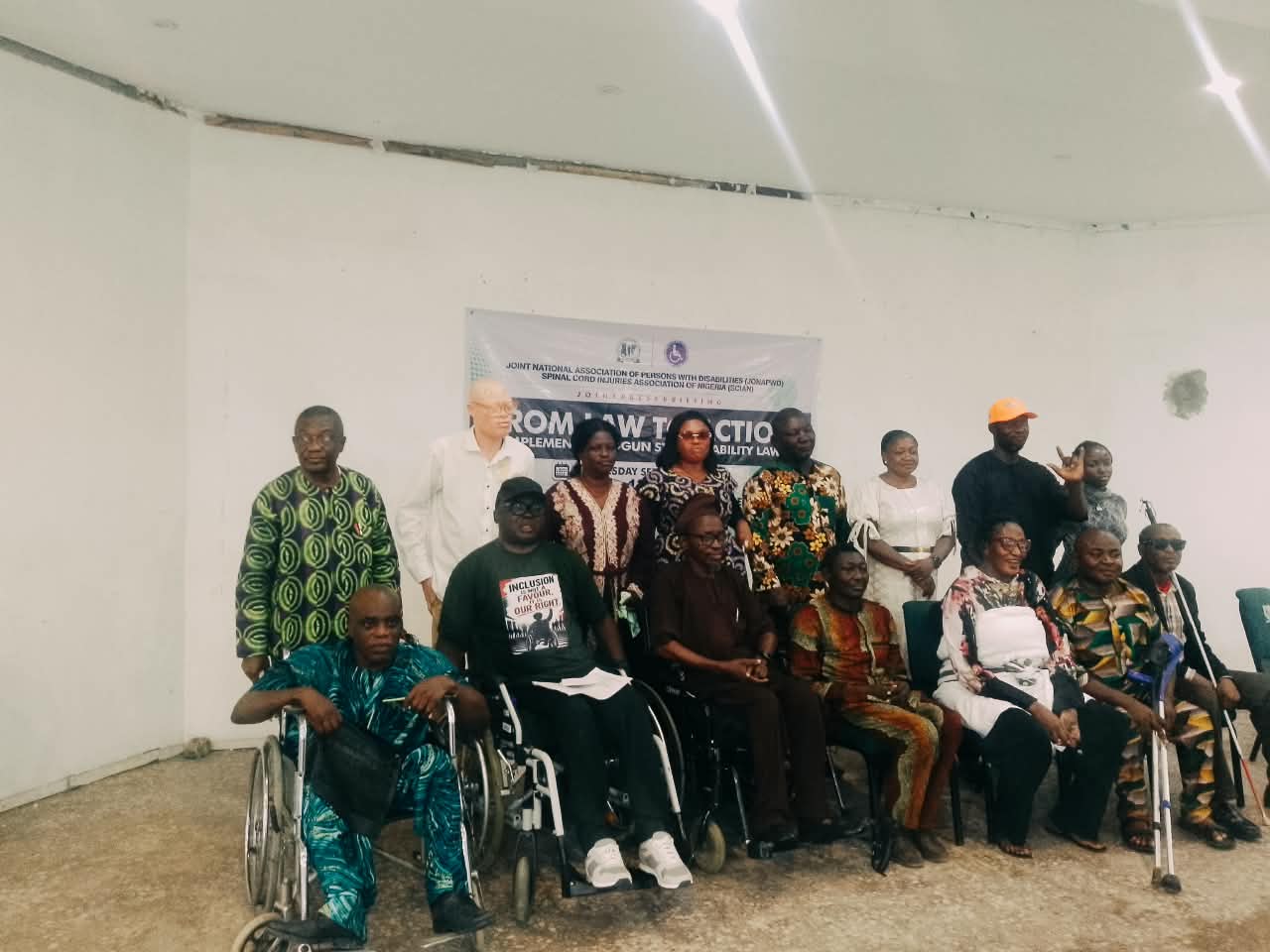
The Joint National Association of Persons with Disabilities (JONAPWD) and the Spinal Cord Injuries Association of Nigeria (SCIAN) have renewed calls on the Ogun State Government to fully operationalise the state’s Disability Law, nearly nine years after it was assented to by the then Governor, Senator Ibikunle Amosun.
The groups made the demand on Wednesday during a joint press briefing held at the Nigeria Union of Journalists (NUJ) secretariat, Abeokuta, under the theme, “From Law to Action: Implement the Ogun State Disability Law.”
The advocacy was supported by the Disability Rights Fund.
Speaking on behalf of the organisations, the National President of SCIAN, Abdulwahab Matepo, said the law, signed on December 27, 2017, had yet to translate into the institutional structures, enforceable protections and accessible systems expected to guarantee the rights of persons with disabilities in the state.
Matepo said the disability community had deliberately pursued dialogue with government and other stakeholders for years, but maintained that continued engagements should now result in measurable action.
“Almost nine years after the law was assented to, persons with disabilities in Ogun State are still waiting to see the legal framework translated into functioning institutions,” he said.
The demand comes amid repeated calls by disability groups for the state to establish a functional institutional framework for disability affairs.
In December 2025, disability advocates similarly called for the gazetting or re-enactment of the law, establishment of a state disability commission and a dedicated budget line for disability affairs.
The groups also drew attention to the size of the population potentially affected by the delayed implementation of disability legislation.
According to JONAPWD’s 2025 estimate, Ogun has about 1,032,221 persons with disabilities.
The organisation, however, describes the figure as an assumptive estimate rather than a direct population census, derived by applying a disability benchmark to National Population Commission population projections.
A recent report also independently described the figure as a projection rather than a census count.
At the global level, the World Health Organisation estimates that about 1.3 billion people, or 16 per cent of the world’s population, experience significant disability.
Matepo said the figures represented real people requiring access to education, healthcare, employment, transportation, infrastructure, political participation and economic opportunities.
He said the continued absence of effective institutional mechanisms had made it difficult for persons with disabilities to secure and enforce the rights provided for under disability-rights frameworks.
The SCIAN president explained that JONAPWD and SCIAN had engaged the Ogun State House of Assembly, Ministry of Justice, Ministry of Women Affairs and Social Development, traditional rulers and other stakeholders as part of efforts to resolve the matter.
He said the organisations had also participated in consultations on possible amendments to the existing legislation after concerns were raised about gaps and provisions considered inadequate or difficult to implement.
In April 2026, a stakeholder consultation was held to discuss the way forward, while the disability community subsequently continued engagements with relevant government officials.
Matepo said a major engagement took place on June 9, 2026, when representatives of the disability community met with the Attorney-General and Commissioner for Justice, Oluwasina Olanrewaju Ogungbade, SAN.
According to him, the Attorney-General assured the delegation that he would work on the matter and provide an update within two weeks.
Matepo said the groups refrained from immediately going public, choosing instead to allow the promised process to run its course and subsequently followed up through correspondence and further engagements.
A report published after the June meeting also said Ogungbade had pledged urgent steps towards addressing the long-running implementation issue.
The Ogun JONAPWD Chairman, Ayo Awobona, said the campaign was not designed to confront the state government but to secure concrete action on disability rights.
He said the organisations had recognised and appreciated government officials who had opened their doors to dialogue but stressed that meetings and assurances must ultimately translate into practical changes.
“We have continued to engage and not confront the Ogun State Government, but advocacy must ultimately be measured by outcomes,” Awobona said.
He said the campaign was about rights, dignity, equality, accessibility, participation and inclusion, rather than charity or humanitarian assistance.
Awobona added that persons with disabilities were citizens who contributed to the economy, raised families, operated businesses, worked in public and private institutions and participated in education, politics, sports and community development.
The disability organisations also addressed concerns that the existing law might require amendment before it could be fully operationalised.
They said they were not opposed to a legislative review and had already submitted proposals aimed at addressing identified gaps.
However, they argued that the amendment process should not become an indefinite justification for delaying implementation.
Their position, according to the statement, was that the existing legal framework should be operationalised in accordance with the applicable legal process while necessary amendments were pursued simultaneously.
They said such an approach would allow the state to address immediate institutional and administrative needs while improving the legislation through the appropriate legislative procedure.
Previous reporting on the issue has also documented concerns about the absence of a functioning implementing agency and gaps in the existing framework.
The organisations said the consequences of non-implementation went beyond legal technicalities, affecting the daily lives of persons with disabilities.
They identified accessibility of public institutions, inclusive education, healthcare, transportation, employment, economic participation, protection against discrimination and harmful practices, as well as political participation, among the areas requiring urgent attention.
The groups said their radio advocacy campaign between August and September had focused on these issues and sought to increase public understanding of the barriers faced by persons with disabilities.
They maintained that disability inclusion should not be viewed as a narrow issue affecting only the disability community.
According to them, inaccessible schools affect children, inaccessible hospitals affect patients, while inaccessible transport systems affect workers, students and other members of society.
The organisations appealed to Governor Dapo Abiodun to provide political direction for the conclusion of the implementation process before the expiration of his tenure.
They urged the governor to direct the relevant government institutions to take concrete steps towards operationalising the law and establishing the institutional mechanisms required to enforce disability rights.
The groups said their appeal was aimed at ensuring that persons with disabilities did not have to restart the advocacy process whenever there was a change of administration.
Looking ahead to the 2027 governorship election, JONAPWD and SCIAN also called on political parties and governorship candidates in Ogun State to make disability inclusion part of their policy agenda.
They urged candidates to publicly state their positions on implementation of the Disability Law and engage directly with persons with disabilities on their plans for inclusive governance.
The groups stressed that their advocacy was non-partisan and that they were seeking commitments from whoever eventually receives the mandate to govern the state.
They also called on the Independent National Electoral Commission to ensure that the 2027 electoral process was accessible to persons with disabilities, including accessible polling units, voting materials and appropriate assistance where required.
The organisations said persons with disabilities should be able to participate fully in elections and other democratic processes without physical or institutional barriers.
Concluding the briefing, Matepo and Awobona said the disability community had demonstrated patience through letters, meetings, consultations, courtesy visits, legal engagements and public awareness campaigns.
They therefore urged the state government to move from consultation to commitment, commitment to action and from a law on paper to a law that operates in the daily lives of persons with disabilities.
 '
' '
'Do you want to share a story with us? Do you want to advertise with us? Do you need publicity for a product, service, or event? Contact us on WhatsApp +2348183319097 Email: platformtimes@gmail.com
We are committed to impactful investigative journalism for human interest and social justice. Your donation will help us tell more stories. Kindly donate any amount HERE
 '
'