

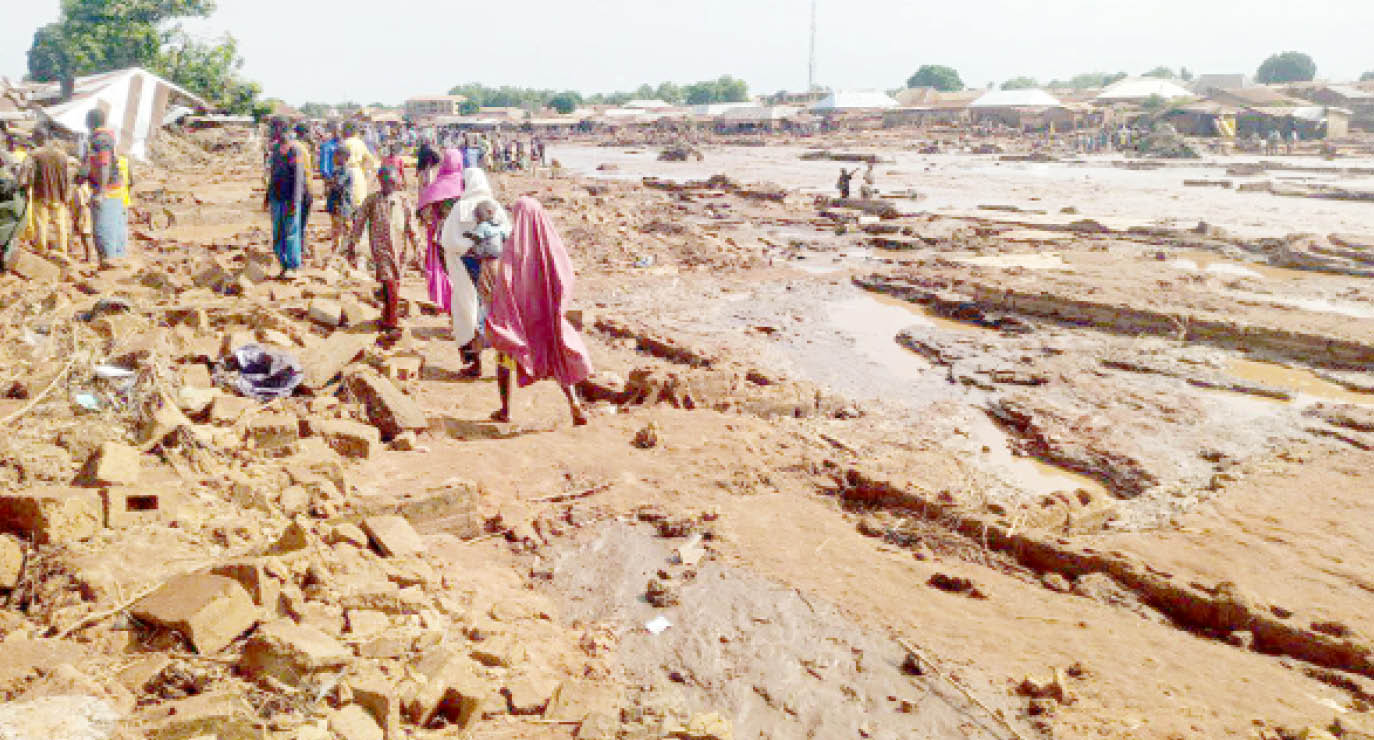
The Nigeria Hydrological Services Agency has warned that Nigeria could witness more devastating floods over the next 12 weeks, cautioning that the current flooding ravaging Lagos and other parts of the country marks only the beginning of what could become a more severe rainy season.
The Director-General and Chief Executive Officer of NiHSA, Umar Mohammed, said the flooding witnessed in Lagos last week did not come as a surprise, insisting that the agency had predicted the disaster months earlier but its warnings were largely ignored by relevant authorities.
Speaking through the agency’s Head of Geographic Information System and Remote Sensing, Emmanuel David Tuna, Mohammed warned that the period between July and September would witness sustained heavy rainfall, with flooding expected to peak in August and September if urgent preventive measures were not taken.
“As we speak, this is just the beginning of the rainy season. If nothing is done, what we are seeing now could become much worse, especially around August and September,” he said.
PLATFORM TIMES reports that torrential rainfall which lasted for more than 12 hours recently paralysed commercial activities across Lagos, leaving major roads submerged, forcing schools to shut and stranding thousands of commuters and motorists.
Among the worst-hit areas were the Lagos-Oshodi Expressway, Abeokuta Expressway, Lekki-Epe Expressway, Victoria Island, Ikeja, Agege, Oworonsoki, Gbagada, Funsho Williams Avenue, Iwaya in Yaba and several coastal communities.
Residents also flooded social media with distress videos showing homes, vehicles and businesses submerged while appealing to the Lagos State Government for emergency intervention.
Explaining the persistent flooding, Mohammed said Lagos remained one of Nigeria’s most vulnerable states because it was exposed to three different forms of flooding—urban, riverine and coastal flooding—which could occur simultaneously.
According to him, parts of Lagos are at or below sea level, making natural drainage extremely difficult.
He disclosed that NiHSA’s field investigations revealed that many drainage channels across the state were already filled with stagnant water long before the peak of the rainy season, while several others had been blocked by silt, refuse, plastics and sand.
He said the blocked drainage systems prevented floodwaters from flowing freely into rivers and eventually into the Atlantic Ocean.
The NiHSA boss further explained that rising water from the Ogun River was now combining with urban floodwaters, thereby worsening the flooding situation across parts of Lagos.
He warned that if high ocean tides coincided with heavy rainfall, the state could experience far more devastating floods.
Mohammed also raised concerns over possible contamination of drinking water, saying prolonged flooding could pollute boreholes and other water sources used by residents.
He disclosed that the agency had already conducted pre-flood water quality assessments and would carry out post-flood analysis to determine the extent of contamination and identify pollution sources.
“We are concerned not only about flooding but also about the quality of drinking water after the floods. We already have pre-flood records and will compare them with post-flood findings,” he said.
The NiHSA chief projected that flooding would likely occur intermittently from July through September before gradually subsiding in October, while warning that residents might not experience complete relief until November.
He lamented what he described as poor cooperation from many state governments, accusing them of routinely disregarding annual flood outlooks and early warning advisories issued by the agency.
“We saw this coming and alerted the public through various channels. Unfortunately, our warnings were not taken seriously. Most times, because people cannot immediately see the danger, they ignore our predictions,” Mohammed said.
He urged state governments, emergency management agencies and residents to immediately clear blocked drainage systems, obey flood advisories and strengthen preparedness measures to minimise loss of lives and property as the peak of the rainy season approaches.
 '
' '
'Do you want to share a story with us? Do you want to advertise with us? Do you need publicity for a product, service, or event? Contact us on WhatsApp +2348183319097 Email: platformtimes@gmail.com
We are committed to impactful investigative journalism for human interest and social justice. Your donation will help us tell more stories. Kindly donate any amount HERE
 '
'