

Daud Olatunji
The flood came without mercy.
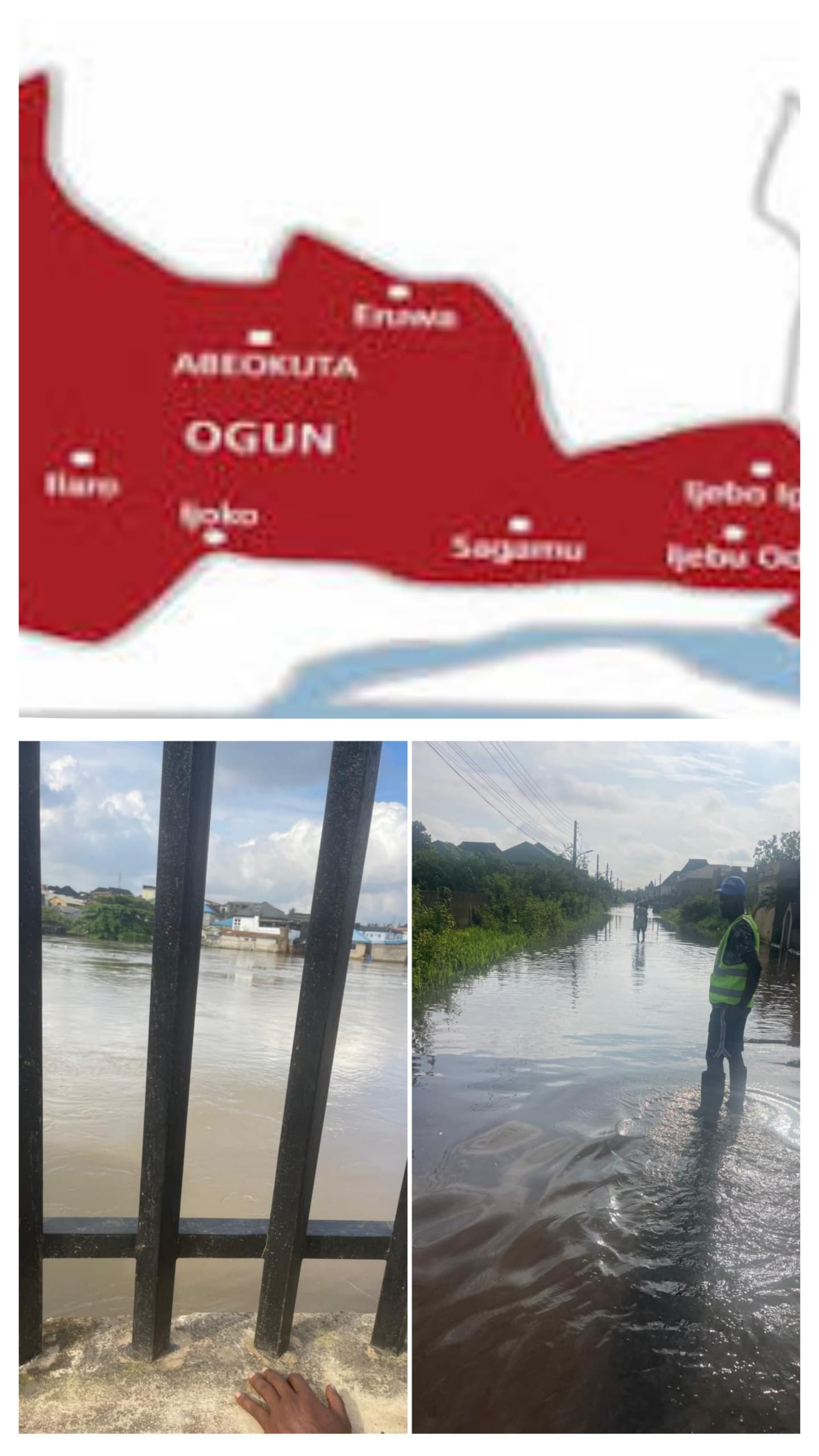
For one family in Isheri, a thriving riverine community straddling the Ogun-Lagos boundary, it claimed the life of an eight-year-old boy.
Elsewhere in the same community, a mansion worth about ₦80 million now abandoned after repeated floods rendered it uninhabitable.
In another flood-prone community in Ogun State, a mother still struggles to forget the horrifying moment raging floodwaters tore her child from her hands. The child’s body was recovered four days later.
For residents of Isheri, Wawa, Arigbabuwo and several riverine communities across Ogun State, flooding has become more than an annual environmental disaster. It has become a recurring cycle of grief, displacement, economic loss and psychological trauma.
Yet, amid the destruction, another story is unfolding.
Instead of waiting for disasters to happen before responding, humanitarian organisations, government agencies, community leaders and residents are increasingly embracing preventive measures that are helping to reduce casualties, improve preparedness and strengthen resilience.
While these interventions have not stopped flooding altogether, evidence from affected communities shows they are increasingly saving lives and reducing losses
…The Scale of Ogun’s Flood Challenge
Official records from the National Emergency Management Agency (NEMA), the Nigeria Hydrological Services Agency (NIHSA), the Nigeria Meteorological Agency (NiMet) and the Ogun State Government show that flooding and severe rainstorms have remained recurring threats across many parts of Ogun State, reinforcing the need for a shift from disaster response to disaster preparedness.
As far back as 2020, the Ogun State Government identified 24 flood-prone communities, including Isheri, Warewa, Kara, Ijoko, Oke-Afa, Yemule, Sokori and Arakanga, urging residents living along floodplains to relocate before the peak of the rainy season.
The warnings proved justified.
In April 2024, a devastating rainstorm swept through Sagamu Local Government Area, affecting eight communities—Araromi, Itun Semo, Kajola, Ayegbami, Jiborisa, Mosu Orisunbare, Agbala and Gbonlu. According to NEMA, houses, schools, worship centres, vehicles, shops and electricity infrastructure were damaged, forcing several families to seek temporary shelter, although no deaths were officially recorded.
During the same month, another severe rainstorm struck Sango-Ota in Ado-Odo/Ota Local Government Area, destroying hundreds of homes and shops, uprooting more than 100 electricity poles and damaging community facilities. NEMA reported that more than 30 people sustained injuries.

Three months later, in July 2024, heavy rainfall caused rivers to overflow in Ifo Local Government Area, flooding 10 communities. Homes, kiosks and business premises were submerged, while residents appealed for government assistance.
The overall official assessments by NEMA and the Ogun State Emergency Management Agency (OGSEMA) show that at least 18 communities across Sagamu and Ifo Local Government Areas were directly affected by floods and severe rainstorms in 2024, while destructive storms also caused widespread damage in Sango-Ota.
Communities such as Isheri and Akute in Ifo LGA; Warewa, Kara and Arepo in Obafemi-Owode LGA; Ijoko in Ado-Odo/Ota LGA; and riverine settlements including Iwopin and Ibiade in Ogun Waterside LGA continue to experience flooding almost every rainy season.
…Crisis Fuelled by Climate Change, Human Activities
Environmental expert and former Ogun State Commissioner for Environment, Asiwaju Tony Ojeshina, believes Nigeria’s flooding crisis is driven by both global climate change and local environmental failures.
“Flooding is a global problem. The excessive flooding we are witnessing today is closely linked to climate change. However, there are also many things we ought to be doing in Nigeria that we are not doing,” he told PLATFORM TIMES.
According to him, decades of industrialisation have increased greenhouse gas emissions, weakened the ozone layer and accelerated global warming, causing polar ice to melt and sea levels to rise.
“When rainfall occurs on top of these already elevated water levels, flooding becomes inevitable,” he explained.
However, Ojeshina argued that many floods in Nigeria are avoidable.
He blamed poor urban planning, blocked drainage systems, indiscriminate refuse disposal and weak enforcement of environmental regulations.
“Most flooding in Nigeria is largely man-made. God created the Earth perfectly, but human activities and our failure to do what is necessary have created these environmental problems,” he said.
…Government Also Shifting Towards Preparedness
Beyond humanitarian interventions, Ogun State has increasingly adopted a prevention-focused strategy.
Following annual flood forecasts issued by NiMet and NIHSA, the state government identified 16 local government areas as highly vulnerable to flooding in 2025 and commenced extensive pre-rainy-season drainage and river-clearance works.
According to the Ogun State Ministry of Environment, the government desilted 988.3 kilometres of rivers, streams and drainage channels and constructed 698 metres of concrete drains and culverts to improve water flow in vulnerable communities.
One of the most significant interventions took place in Isheri, Akute and Warewa.
The ministry reported that the creation of additional tributaries to the Ogun River and sustained dredging of the Opa Aro River have produced measurable results.
Areas in Isheri that previously remained submerged for approximately six weeks during peak rainfall now experience flooding for about three weeks. While flooding has not been eliminated, the shorter inundation period has reduced disruption and improved recovery for residents.
…Searching for Solutions Before Disaster Strikes
Faced with recurring floods, the Nigerian Red Cross Society shifted its strategy from emergency response to disaster preparedness.
Rather than waiting for floodwaters to destroy homes before intervening, the organisation now focuses on early warnings and anticipatory action.
“The Nigerian Red Cross Society has been trying everything within our strength to make sure that disaster regarding flood is under control,” said Ogun State Branch Secretary, Ajayi Taiwo Ezekiel.
“What we’re actually planning towards is anticipatory action. We’re not planning after the disaster. Before disaster, what are we putting in place? That’s our concern because destruction is very expensive.”
The organisation identified flood-prone communities across Ogun State, including Isheri Olofin, Oke-Shokori in Abeokuta North and several communities in Ogun Waterside.
Its intervention includes multilingual radio jingles, community sensitisation campaigns, vulnerability assessments, emergency response training and partnerships with NEMA, OGSEMA, the Nigeria Security and Civil Defence Corps and the Ministry of Environment.
One of the programme’s major innovations has been the installation of water gauges in flood-prone communities.
Residents are trained to monitor river levels and immediately report changes to emergency coordinators.
“We train community members to read the water gauge. Whenever the water rises to a dangerous level, they send us pictures and reports. With that, we’re able to monitor the rise and fall of the water,” Ezekiel explained.
The early-warning system allows residents to evacuate before floodwaters become life-threatening.
Preparedness is complemented by financial support. Through the IFRC-funded REBUMAA project, vulnerable households receive Cash Voucher Assistance through ATM cards.
Over the past three years, about 2,000 households have benefited across flood-prone communities in Ogun State.
Otun Omobayode, Red Cross Division Coordinator covering Obafemi-Owode and Isheri, said about 200 beneficiaries in his jurisdiction each received ₦77,000, alongside blankets, raincoats, food items and life jackets.
“You know somebody who doesn’t know what to eat tonight or tomorrow morning. Giving such a person almost ₦77,000 goes a very long way,” he said.
…Signal the Response Is Working
The improvements reported by residents align with broader government and community assessments.
Interviews conducted by PLATFORM TIMES indicate that although residents in Isheri, Warewa, Kara, Abeokuta, Ogun Waterside and Sagamu still experience seasonal flooding, early-warning systems, drainage improvements, community sensitisation and coordinated emergency planning are helping to reduce losses, shorten recovery periods and enable households to prepare before floodwaters arrive.
Omobayode said communities once caught unaware by midnight floods now receive advance warnings through the water-gauge monitoring system.
“For the past two or three years now, I think we’ve not been able to record any serious disaster like before,” he said.
The Liken of Iwopin, Oba Adeniyi Sunday Agbojo, also confirmed the improvement.
He said “the last flooding happened at midnight. But thanks to the awareness the Red Cross has taught residents, they were able to quickly help themselves. Thankfully, no life was lost during the last flooding disaster.”
Mrs Olabode Abiodun, Public Relations Officer of Isheri Estate Community, said awareness campaigns have transformed residents’ attitudes.
“In the past, some residents underestimated the danger. Today, residents are better informed. They understand what to do before, during and after flooding.”
She said many households now prepare emergency kits, move valuables before floodwaters rise, protect important documents and reinforce homes with sandbags.
“The support is not just about food or money. The knowledge they have given residents is equally valuable.”
…The Solution Has Limits
Despite the progress, flooding continues to inflict enormous economic and emotional losses.
Mrs Abiodun said, “We are talking about billions. Imagine someone who built a house worth about ₦80 million and eventually had to abandon it because of flooding.”
She added that emotional trauma cannot be quantified.
Flooding has also disrupted children’s education, forcing pupils in the past to cross floodwaters by boat before a primary school was established within the community.
Omobayode estimated that affected communities have lost nearly ₦500 million worth of property over the past three years.
Residents also demanded improved drainage systems, erosion-control projects and compensation for destroyed properties.
…The Risk Remains
Despite ongoing interventions, the threat has not disappeared.
The 2026 Annual Flood Outlook released by NIHSA classified 19 local government areas in Ogun State as being at risk of flooding.
The report forms part of a nationwide assessment identifying more than 14,000 communities across Nigeria as vulnerable to flooding, underscoring the need for sustained preparedness, continuous public awareness and long-term resilience measures.
Ojeshina warned that humanitarian interventions cannot replace government responsibility.
“The Ministry of Environment must ensure proper waste management, enforce environmental regulations and provide adequate drainage infrastructure. If governments fail to prioritise these responsibilities, flooding will continue regardless of individual efforts.”
…Lessons for Other Flood-Prone Communities
The experience of Ogun’s riverine communities demonstrates that climate adaptation is not only about building dams or responding after disasters.
Evidence gathered by PLATFORM TIMES shows that simple, community-based interventions can significantly reduce risks.
Experts said that early-warning systems give families time to evacuate as drainage improvements shorten periods of inundation.
They are noted that cash assistance helps vulnerable households recover faster, as community education improves preparedness.
There is also call for partnerships among humanitarian organisations, government agencies and residents to strengthen resilience.
For Ojeshina, prevention remains the most effective strategy.
“Governments should not wait until disasters occur before taking action.”
He urged residents to keep drainage channels clean, dispose of waste properly, incorporate drainage into building designs and plant trees to reduce environmental degradation.
The environment expert said climate change may continue to intensify rainfall, but the experience of Isheri and neighbouring communities suggests that preparedness can make the difference between tragedy and survival.
The floodwaters still rise every rainy season. Increasingly, however, more residents know when to leave, where to go and how to protect what remains.
That knowledge, community leaders say, is proving just as valuable as the relief materials that arrive after the waters recede.
####
 '
' '
'Do you want to share a story with us? Do you want to advertise with us? Do you need publicity for a product, service, or event? Contact us on WhatsApp +2348183319097 Email: platformtimes@gmail.com
We are committed to impactful investigative journalism for human interest and social justice. Your donation will help us tell more stories. Kindly donate any amount HERE
